Insights on Zero Trust in Cloud Security Environments
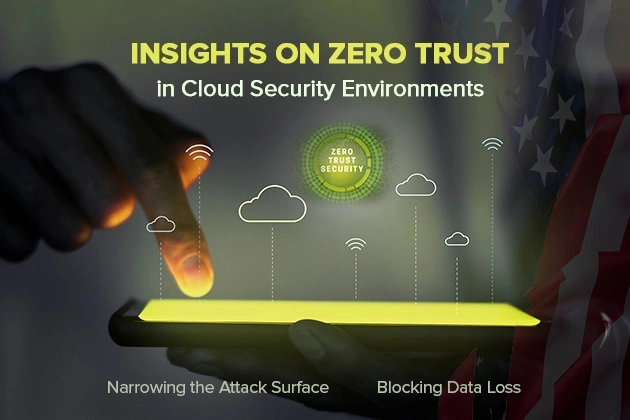
Zero Trust Architecture (ZTA), a cybersecurity framework, is built on the foundational principle of “never trust, always verify.” As an IT security model, Zero Trust in cloud environments eliminates the trust assumption to protect data, applications, and networks. Unlike the old security model that draws a clear line between trusted insiders and outside threats, zero trust flips the script by treating everyone as a potential risk, no matter where they are.
Zero-trust solutions allow only legitimate application communication and traffic by enabling segmentation. By leveraging a least-privileged access strategy, Zero-Trust architecture stringently enforces access control. Implementing Zero Trust in an enterprise network involves the establishment of boundaries and the enforcement of access controls to safeguard sensitive applications from unauthorized access.
Why Zero Trust Architecture is Important?
Enterprises today are continually undergoing rapid digital transformation, fundamentally driven by cloud adoption, IoT devices, hybrid work environments, and SaaS applications. This tech-powered transformation led to the obsolescence of traditional network security, unveiling critical weaknesses in the perimeter-based models built on VPNs and firewalls. These legacy tools failed to keep pace with the required agility and sophistication of modern enterprises, increasing cyber risks in the modern-day world.
As a solution to these challenges, a zero-trust architecture emerged, rethinking security from a “never trust, always verify” approach. It is engineered to overcome the vulnerabilities of traditional architectures, ensuring secure connectivity for devices, users, workloads, B2B partners, and IoT systems.
Zero Trust Architecture: Reimagining Traditional Security
Instead of securing networks, zero trust secures direct access to IT resources. Zero Trust governs access depending on risk and context, not based on identity. A purpose-built cloud is a service architecture that acts as an intelligent switchboard, enabling secure, one-to-one connections between workloads, devices, branches, users, and applications, irrespective of their location. By decoupling security and connectivity from the network, organizations leverage the internet as their corporate network.
The Four Pillars of Zero Trust
1. Traffic Inspection
By leveraging a high-performance security cloud, zero trust inspects all traffic at scale, including encrypted traffic. The real-time policies associated with zero trust block threats before they attack users or applications.
2. Narrowing the Attack Surface
Organizations can hide applications behind a zero-trust cloud, eliminating the need for public IP addresses and preventing inbound connections. As applications become invisible to the internet, the attack surface gets reduced.
3. Blocking Data Loss
Zero-trust architecture secures sensitive data across potential data leakage sources, whether in transition to the web, in use on endpoints, or at rest in the cloud.
4. Preventing Lateral Movement
Unlike traditional security models, zero trust connects users directly to applications and not to the network. This segmentation ensures attackers do not move laterally between resources, efficiently preventing breaches.
Zero Trust Architecture for a Cloud Environment
In the modern-day tech-driven business environment, it is more cost-effective to host an application in the cloud instead of a data center. Studies have shown that over 73% of companies today have applications or infrastructure in the cloud. Operated by cloud service providers and SaaS vendors, these cloud environments are not associated with an organization’s network. Hence, the same network controls are not applied to these environments, leading to distributed applications and data across multiple locations. Companies are also losing track of who is accessing their data and apps and what devices are being used to access them. In response to these issues, companies leverage a variety of access technologies depending on their asset locations, creating a fragmented security architecture. As cloud environments change continually, their approach to security must be adaptable and comprehensive. Thus, companies must have a single, unified security architecture that ensures secure access to company apps and data across public cloud, private data centers/cloud, and SaaS apps. This security infrastructure also provides controls and limits to the accessibility and usability of the assets. By inspecting traffic and enforcing security policies daily, a zero-trust architecture maximizes the prevention of cyber threats across the cloud. As organizations worldwide move to the cloud, it is crucial to integrate Zero Trust into the cloud infrastructure design.
Zero Trust AI Security: An Evolution of Cybersecurity Strategy
Zero Trust AI Security is an integrated two-transformative approach to cybersecurity: (i) the zero trust model and (ii) artificial intelligence-driven threat identification and response. This combined approach creates a dynamic security architecture that continuously monitors, validates, and adapts to evolving threats. Studies have shown 96% of organizations throughout the world favor a zero-trust approach, and 81% plan to implement zero-trust strategies by 2026.
Companies that implemented Zero Trust AI Security reported 76% fewer breaches and decreased incident response times, marking the business value of this approach. By leveraging machine learning algorithms, the zero-trust model becomes effective enough to identify patterns, detect threats, and automate responses at a speed that human security teams can never match. This Machine Learning Cybersecurity model is highly adaptable to the modern-day, continually evolving cybersecurity landscape, requiring companies to rethink their security strategies.
Zero Trust Security Core Principles
The fundamental principles underscoring the development of a zero-trust architecture are as follows:

1. Explicit Verification
In a zero-trust cloud environment, every access undergoes rigorous authentication and authorization processes, including multi-factor authentication (MFA), risk-based authentication, continuous validation, contextual analysis, and identity and access management (IAM).
2. AI-Powered Intelligence
AI integration enhances zero-trust effectiveness by processing huge datasets and identifying subtle indications of threats. Through behavioral analytics, this model detects anomalies by establishing normal patterns. Predictive threat modeling helps forecast potential attacks, automated policy enforcement adjusts to dynamic security controls, and real-time risk scoring continuously evaluates access requests legitimacy.
3. Assuming Breach Mentality
Zero-trust security architectures operate under the assumption that defenses have already been breached, demanding continuous monitoring and rapid responses. Lateral movement prevention and network segmentation restrict internal network traversal and separate critical assets, and limit access.
4. Applying Least Privilege Access
Through approaches like Just-in-time access, role-based access control, privileged access management, attribute-based access control, and microsegmentation, organizations deploy granular access controls that offer users only the minimum permissions required.
With The Silicon Journal, readers are now exposed to a plethora of business knowledge, empowering their decision-making and business awareness to stay competitive.
Related Articles


Recent Articles



Latest Issue