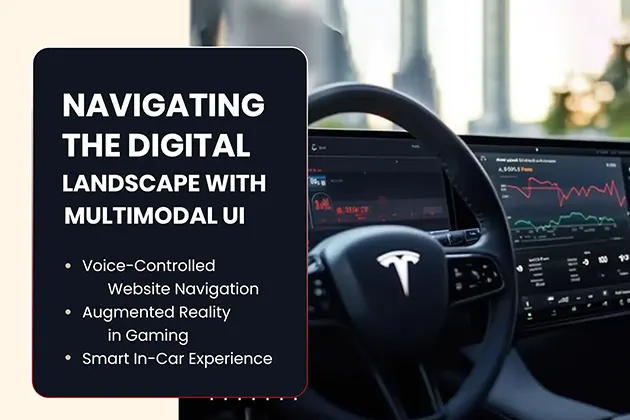
Navigating the Digital Landscape With Multimodal UI
Digitalization has taken an innovative turn with the introduction of multimodal user interfaces, designed to deliver more transparent, powerfully expressive, and more flexible ways of human-machine interaction or human-computer interaction. While representing a paradigm shift from the conventional window-icons-menus-pointing device interfaces, Multimodal User Interface Navigation emerged as a more dynamic system that combined two or more user input nodes with multimedia system output. As modern users prefer to interact multi-modally in many applications, their inclination toward multimodal interfaces has grown exponentially.
Widely being preferred over unimodal equivalents, these interactive systems are offering something that has revolutionized human-machine interaction. By recognizing naturally occurring forms of human language and behavior, and integrating recognition-based technology such as vision, speech, or pen, these interfaces seek to leverage natural human capabilities to communicate with users via gesture, facial expression, touch, speech, and other modalities.
Moving through the discussion on the Multimodal User Interface (MUI) Theory, this article delineates the advantages of this interactive system and how it is revolutionizing human-machine interaction through sensory and other input nodes.
Understanding Multimodal User Interface Theory
MUI Theory posits that “perceptual experiences do not match or approximate properties of the objective world, but instead provide a simplified, species-specific, user interface to that world.” Donald D. Hoffman stated that perception is an interface that conceals objective reality behind the curtain of helpful icons. On the one hand, humans have unalloyed physical properties. On the other hand, we have propositional attitudes and conscious experiences. Seeing is a constructive and active process. What humans see is a symbolic interpretation of the world, and they do not have direct knowledge of objects in the world. The assumption that there is a mind-independent objective in the physical world has proved to be inappropriate. Hence, to explore the scientific theory behind the relationship between conscious experiences and the brain, Donald D. Hoffman evaluated that sensory experiences consist of a multimodal user interface between the perceiver and an objective world. He also points out that the objective world itself is comprised of conscious agents.
According to the MUI theory, a user interface serves the purpose of useful simplification. In this regard, the theorist presented an example. Suppose you are writing a letter, and there is a reddish square icon on the computer screen for the text file of that letter. Now, the question is: “Does this reddish square icon resemble that text file? Is the text file itself reddish or square?” The answer would obviously be no. As the icon does not indicate the file’s position or colour and shape, it clearly shows that the icon does not resemble the text file. But does that mean the icon is a useless misrepresentation of the text file? The answer once again would be no. By clicking on the icon, you can open the text file and modify its content. The icon in that case lets you interact with the text file, even though it doesn’t have any resemblance to it. Hence, icons of an interface need not resemble the items they represent to be useful. The purpose of the interface is to let you interact smoothly with the computer while hiding its complexities.
Components of an Effective User Interface
An effective user interface possesses various characteristics:
1. Two or More Combined User Input
Multimodal interfaces process two or more combined user input modes, such as pen, speech, gaze, body movements, and manual gestures, in a coordinated way with multimedia system output. Input modalities in these systems encompass touch or pressure, eye movement, hand or body gestures, brain signals, emotions, handwriting, and voice-or-speech-based commands.
2. Multimedia System Output
Output modalities in a MUI consist of smart visual representations, virtual reality, speech synthesis, generated graphics and videos, various auditory cues, and tactile feedback.
3. Sensor Technologies
MUI comprises sensor technologies that capture the modalities of magnetic or acoustic sensors, computer vision, digital paper, and touch-sensitive surfaces that could sense hand, lip, arm, pen, eye, and torso motions. These are further characterized and classified in several feature spaces for understanding.
4. Recognition-Based Systems
Recognition-based systems are an essential component of MUI. These are crucial for interpreting signals from different sources, such as interpreting facial expressions, recognizing speech patterns, and understanding gestures. These contribute to more efficient human-computer interaction.
5. Multimodal Signal Processing
Multimodal signal processing (MSP) focuses on the analysis, processing, and coupling of information from multiple communication sources, which may include, but are not limited to, graphics, texts, handwriting, video, gestures, speech, and hand or body movements, ensuring an enhanced human-computer interaction by creating more natural interfaces capable of interpreting various forms of human expression.
6. Intelligent User Interfaces
Intelligent user interfaces deliver adaptivity, task assistance, context sensitivity, and multimodal systems support to more than one type of communication channel.
Examples of Effective Multimodal User Interfaces
Today, humankind is experiencing the wonders of technology each day, and MUI is one such wonder that has dramatically transformed human-machine interaction in the last decade. Listed below are some of the examples of advanced MUI applications in our day-to-day lives.
1. Voice-Controlled Website Navigation
Voice-Controlled Website Navigation is one of the most common uses of MUI in our daily lives now. It allows users to interact with search and browse websites without using a mouse. We can navigate a website hands-free through spoken commands. Through this interactive system, users with disabilities can easily search through auditory sensors, ensuring accessibility and inclusivity for all users.
2. Smart Home Speakers
Amazon, Google, and Apple are dominating in this MUI system. With smart home speakers like Apple’s Siri or Amazon’s Alexa, we can perform various home tasks such as switching lights, controlling the music system, shopping, and similar tasks with voice commands.
3. Augmented Reality in Gaming
With augmented reality, users use multiple input modes, such as audio, audio-visual speech processing, and visual methods to enhance the gaming experience. It demands high-quality graphics and design processes for audio-visual speech processing in gaming. These augmented reality experiences are now spanning other industries as well.
4. Smart In-Car Experience
By combining connectivity to the physical environment, companies like Tesla, Volkswagen, and Toyota are unlocking outstanding vehicle experiences. For a high level of communication, these multimodal systems are facilitating the development of smart cities with traffic-facilitated in-car experiences.
The Silicon Journal brings to you detailed information, news, and discussions on recent topics, events, and technologies that are ruling the business world. As an emerging business magazine, we are committed to delivering information to the best of our readers’ interests.
Related Articles


Recent Articles





Latest Issue