Household Technology Reinvented: New American Homes
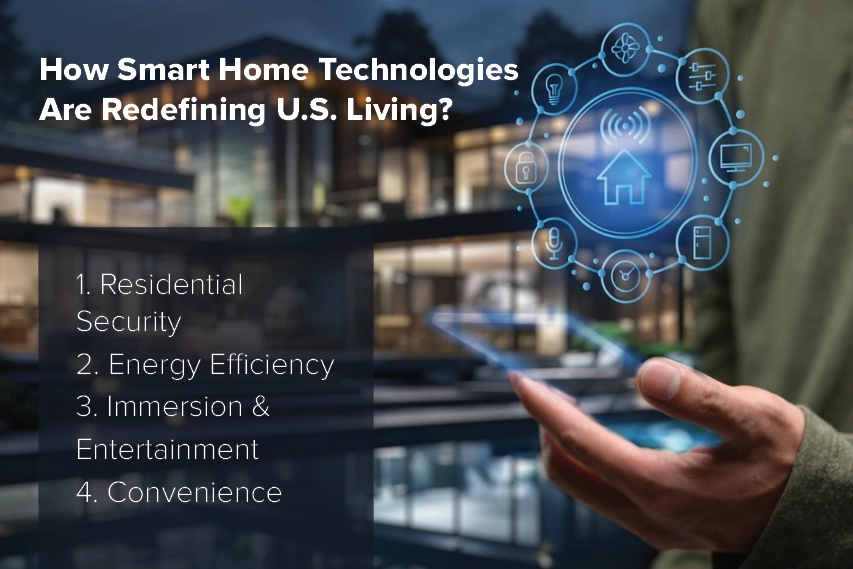
Smart home sales were predicted to skyrocket in 2024, with the number reaching $38 billion, and the revenue was expected to reach $46.77 billion in 2025. Presently, the country has 47.4 million smart homes, a notable improvement in household technology in America.
As the article delineates the drivers of home tech advancements in the USA, it shows how innovation has reached US homes and improved living standards.
Tech Adoption by U.S. Households: People’s Way to Smarter Living
Alexandra Deschamps-Sonsino, in her book ‘Smarter Homes: How Technology Will Change Your Home Life,’ has mentioned that although developments such as ‘controllable plugs,’ ‘light bulbs that change color on demand,’ or ‘shopping list or playlist controlled by voices or mobile applications,’ have occurred in the last five years, the resulting services, behaviors, and spaces people are imagining, designing, and prototyping in the labs today were already part of our lives 100 years ago. She further pronounced, “Ironically, the concept of the smart home is helping us free ourselves from home-centric economic dynamics. We are slowly reconnecting with communities of small, local entrepreneurship, city-based economies, and behaviors of the pre-industrial era.”
Modern-day homes and people’s living standards underscore “the violent intrusion of science, welfare laws, and the industrial and economic needs of the late nineteenth century. Technology, design, architecture, and interior design became tools to help us swallow the pill of social and economic change.” 2017 marks the beginning of changing the rhetoric of the “smart home”) when the concept was taken out of its industrial context to rewrite the narrative.
As we reach the end of 2025, “Alexa, turn on the music,” “Alexa, turn on the lights,” are some of the common phrases we heard throughout the year in American households. As Bluetooth-enabled technology continues to influence American lives, its integration with doorbells, lights, and other household items revolutionized the way people lived before. A recent Statista report revealed that Smart TVs, smart speakers, and digital streaming devices are the most commonly used smart home devices by Americans. Apart from that, security and safety devices, energy management devices, and smart appliances are used by the majority of American residents.
Homes in the U.S. are becoming smarter through technological integrations. By offering a technological advantage to their counterparts, smart home devices that are IoT-connected and digitally enabled are dominating the smart technology industry in the country. Continued innovation and technology offer opportunities to enhance the durability, comfort, and indoor air quality of American homes. These advances help transform people’s homes into safer and more comfortable residential areas.
The U.S. Department of Energy’s (DOE) Building America Program has helped U.S. households save up to %54 billion and reduce the emission of 500 million tons of carbon dioxide. So far, DOE reported as much as $170 in homeowner savings by the Building America Program.
This program improved the home heating and cooling systems’ efficiency by 30% through the deployment of energy-saving technologies and techniques. A recent report shows that 94% of Americans have at least one smart device in their home right now. Amazon’s Alexa is one of the favorite voice assistants of 55% of Americans, followed by Apple’s Siri. Research suggests 27% of Americans use a voice assistant to control their smart home technologies. Americans have spent an average of $1,172 on smart tech devices for their smart homes. Safety and security, convenience that comes with smart tech, and the ability to control the home from a distance are some of the key reasons Americans are willing to invest in smart home devices.
Are These Smart Home Technologies All Smarter?
Such convenience, accessibility, and smart configuration of these technologies often make it hard to question their reliability. Despite the convenience, these devices can often malfunction like any other technology. Research has identified that 40% of users reported that they have contacted customer service about their devices at least once. Among all the smart devices, security cameras require the most assistance from customer service, followed by smart TVs. 76% American users expressed their concerns about privacy, spying, targeted marketing, and third-party app hacking associated with smart home technologies.
Tracing Back the History of Smart Homes and Improvements in Living Standards
Technological integration in U.S. households has its roots ingrained in the social conditions that influenced the process. The 20th century witnessed a dramatic revolution in domestic technology that culminated at the end of the century with the concept of “smart home.” With the introduction of information technology in the last quarter of the century, the opportunity to exchange information between people, systems, networks, and appliances in and outside homes was explored.
Since then, technological integrations have increased US living standards compared to the 1980s. According to a Mintel research of 2023, 51% of American consumers reported that home security automation has been their main motivation behind the adoption of smart home devices. Smart cameras, smart door locks, and smoke detectors are no longer luxuries; they have become an essential part of everyday living. 77% of smart home users in the country say that these devices have improved their quality of life, mostly through remote home monitoring and real-time alerts.
However, America’s adoption of home technology is not merely security-driven. According to the U.S. Department of Commerce and Secure Data Recovery, 72% of smart home users have embraced entertainment-centric tech such as Smart Tvs, VR headsets, or streaming tech. This reveals that for many Americans, smart homes were for enjoyment, immersion, and smart living solutions.
Purchasing, installing, and maintaining home technologies involve a lot of spending. Average Americans spend around 2 hours per week managing app-controlled home systems, from alert addressing to software upgrading. Compared to women, men spend slightly more. The paradox associated with smart home adoption is that despite Americans’ love for smart home innovation and the way it makes their homes feel like home, many still don’t feel secure using these devices. As privacy and digital safety concerns continue to hover, we may have suspicions regarding the growth of residential automation in the country.
As a trusted provider of business and industry information in the USA, The Silicon Journal stands as a testament to relevancy, ethics, and trust in media information sharing. Our business publication is committed to presenting all relevant news, trends, and topics associated with the business world.
Related Articles


Recent Articles




Latest Issue