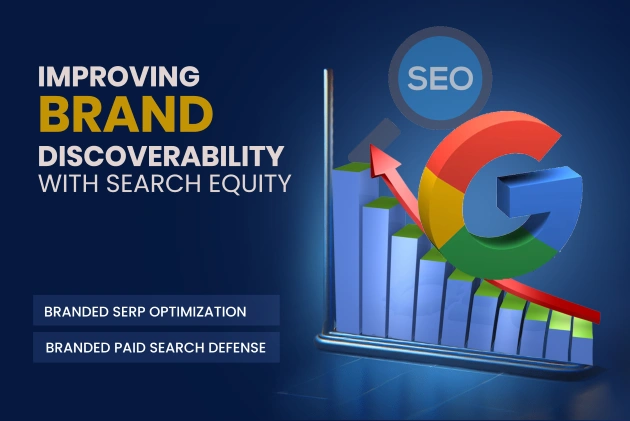
Improving Brand Discoverability with Search Equity
Search Engine Optimization (SEO) is a term that all businesses today are focusing on, not merely as a tool to drive web traffic, but as a strategic step towards expanding business revenue. Despite SEO’s endless possibilities for improving business competitiveness, many companies are doubtful about its impact on consumer experience. In response to the doubts, Google has integrated practices to enhance search equity. Improving brand discoverability with search equity optimization is the primary motivation for businesses to integrate search equity practices into their operations.
This may raise a question in your mind: if search equity is capable of doing what SEO does, increasing brand visibility, then what is the difference between the two? What differentiates search equity from other marketing activities?
Search Equity: What It Is?
Search equity is a website’s capability to compete and rank in the search engine result page (SERP), without being hindered by technical structures. It is a site’s ability to rank its content solely because of its ability to be worthy of consuming by readers. Through search equity, websites with limited resources can compete on the SERP. Without an overly complex understanding of SEO from a content structure and a technical perspective, small businesses can achieve a competitive position for their website on the search engine results page. It offers a business owner the ability to be visible on the SERP and helps them preserve the overall web health. However, one should remember that it is not possible to have total search equity.
At The Silicon Journal, we work tirelessly to help our website rank higher in the SERP by leveraging search equity. The Silicon Journal is a popular business magazine in the USA committed to empowering readers, business enthusiasts, business owners, leaders, and entrepreneurs with every relevant and trending information associated with the global business, economic, and social world.
Importance of Search Equity: Why Is It Necessary?
After reading the article so far, you might have understood that search equity is highly necessary for an average website to increase its visibility on SERP. Business owners are highly concerned about the subject matter related to their business. Now, the problem is that when a business decides to dedicate the time and resources to craft content, they are now facing expectations like optimizing the page structure, external linking, title tags, internal linking, keyword cannibalization, canonical tags, and factors required for successful search engine optimization.
An abundance of content and a lack of it at the same time creates a gap for Google. The gap is not in the quantitative amount but in the quality of the content. To completely capitalize on the content creation resources, Google has stepped towards search equity.
The Difference Between SEO and Search Equity
As of now, Google uses specific criteria to determine a website’s rank. These criteria can include the uniqueness and quality of the content, ease of navigation, page loading speeds, the use of keywords, and other aspects. Websites capable of meeting these criteria are the ones that rank at the top of the search results. Unlike SEO, where the technicality of optimizing a website’s ranking is the main factor, search equity prioritizes the content’s quality as the primary ranking factor. Under this model, high-quality content that delivers the most value to the reader, i.e., the most accurate information and high reader engagement, is the ones that rank the highest on SERP.
The Shift in the Search Engine Landscape
Since 2025, there has been a shift in the Search Engine landscape. It is now clearly evident that people today do not just “Google “ to discover brands. The definition of discoverability is also changing. People are now researching brands on Reddit, finding them on TikTok, and watching videos about a brand on YouTube. Discoverability is no longer about Google ranking only; search equity and cross-platform discoverability are now rewriting brand stories.
You must be consistent in making your brand visible across multiple platforms, and make sure that the search equity is maintained in all of them. While showing up consistently across the touchpoints of the audience’s search universe, you are allowing cross-platform discoverability for your brand to rank on all platforms. In the past, search was considered a place where intent was captured, and results were provided. But that narrative has changed now. Search is now embedded across experiences, platforms, and formats. What once started passively has now become more active with search equity across various platforms. Cross-platform search is intent-led, differentiating from traditional search and defining modern search.
Why Search Equity Stands Out in Marketing?
Search equity stands out from other marketing activities in terms of the value they deliver. As understood before, search equity refers to the lasting authority a brand builds in search engine results (SEO). Conversely, general marketing activities are more tactical and immediate efforts to generate sales and brand awareness.
Search equity is the accumulated visibility, value, and credibility that a brand builds online. It is the authority that a website creates through organic rankings and long-term search marketing. Whereas general marketing activities, such as print ads, social media campaigns, email marketing, and direct promotions, are designed to attain immediate goals like sales, increased awareness, and lead generation. However, they are often time-bound, technical, and targeted to a specific audience segment.
Search equity delivers a lasting value, keeping the brands visible even with reduced marketing spending. On the contrary, a social media advertisement stops driving results just after the business owners run out of money. Prioritizing consumers’ perception of trustworthiness, quality, and brand association, search equity ensures high brand visibility.
How to Reclaim Lost Search Equity Market Share?
Reclaiming lost search equity market share demands precision, speed, and data-driven execution. When branded search volume declines or competitors outrank business-owned assets, brands must act strategically to rebuild visibility, authority, and consumer trust. Here are five proven strategies to regain lost search equity market share for businesses.
1. Branded SERP Optimization
Your branded search engine results page (SERP) is prime digital real estate. Studies show that over 68% of online experiences begin with a search engine. Optimize title tags, meta descriptions, schema markup, and sitelinks to dominate branded queries. Secure featured snippets and control knowledge panels where possible. By strengthening technical SEO and structured data, brands push competitors down the results page and reassert ownership over branded traffic.
2. Content Gap & Competitive Benchmarking
Lost search equity often stems from competitors outranking you on high-intent keywords. Conduct a detailed content gap analysis using tools like SEMrush or Ahrefs to identify missing pages and underperforming content. Refresh outdated assets with updated statistics, FAQs, and long-tail keyword integration. According to HubSpot, companies publishing optimized content consistently generate 55% more website visitors, making content expansion critical for regaining search share.
3. Authority Rebuilding Through Digital PR
Backlinks remain one of Google’s strongest ranking factors. A focused digital PR strategy—guest articles, industry reports, and media coverage—rebuilds domain authority. High-authority backlinks signal trust and improve rankings for competitive keywords. Even a modest increase in referring domains can significantly impact visibility in crowded markets.
4. Branded Paid Search Defense
Competitors frequently bid on branded keywords, siphoning traffic. Running paid search campaigns on your own brand terms ensures top placement and message control. Google data indicates paid ads can increase brand recall by up to 80%, helping brands intercept traffic and reclaim lost clicks.
5. Reputation & Review Management
Search equity is influenced by consumer trust signals. Encourage positive reviews, respond strategically to negative feedback, and optimize local listings. BrightLocal reports that 87% of consumers read online reviews before engaging with a brand. Strong ratings improve click-through rates and reinforce brand credibility in search results.
Alignment of SEO, authority building, paid defense, and reputation management are some significant strategies to reclaim lost search equity market share and restore competitive dominance.
Related Articles


Recent Articles





Latest Issue