Border Security and Migration Control Technologies in America
The American Civil Liberties Union (ACLU) has been at the forefront of every major legal grapple on behalf of immigrants’ rights for more than 25 years. Immigration enforcement and American civil liberties are integral parts of the fundamental constitutional protections of every person, regardless of their immigration status. The Immigrants’ Rights Project of the ACLU is committed to expanding and enforcing the civil liberties and rights of immigrants, helping them stand against any public and private discrimination. By leveraging impact litigation, public outreach, and advocacy, the ACLU protects the rights and liberties of immigrants.
While targeting laws that deny immigrants access to the courts, discriminate based on nationality, and impose mandatory and indefinite detention, the ACLU has been fighting to protect immigrants’ rights for more than 25 years. According to ACLU, “we have challenged constitutional abuses that arise from immigration enforcement at the federal, state, and local levels, including anti-immigrant 'show me your papers' laws at the state level and unconstitutional enforcement tactics by the federal government and local agencies.”
Privacy at Border Security: What’s at Stake?
According to the Fourth Amendment of the U.S. Constitution, all people within the United States are granted protection from unreasonable searches and stops. Despite the broader powers of the federal authorities at entry points, the government has consistently developed programs regarding new technologies for travelers to remain protected against unreasonable stops and searches at the border.
As instructed by the government, the U.S. Customs and Border Protection (CBP) Officers may operate immigration checkpoints within 100 miles of the country’s external border. However, every day at checkpoints, border agents are unlawfully interrogating, searching, and stopping individuals with no suspicion of illegality and wrongdoing, and often in a racially biased manner.
These alarming and unconstitutional practices have increased government intrusion into private lives, such as advanced identification and tracking systems, intrusive technological schemes, and suspicionless searches of electronic devices, watchlist and database systems. This dragnet approach of the government to immigration and law enforcement at the border has put us all into the circle of suspicion.
Border Security Technologies at a Glance
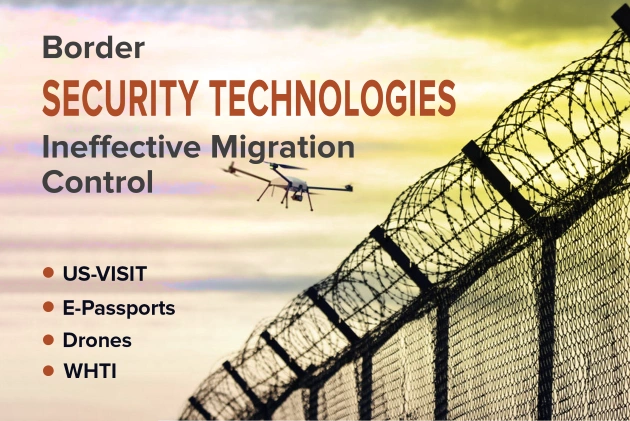
As the U.S. government is stringently focused on keeping the borders safe, its approach is marked by an increased focus on high-tech contrivance and inefficient identity-based security. What’s worse is that the programs designed for border security purposes are expanding toward the rest of the country. ACLU points out that the security technologies implemented to protect border security are invading the domestic lives of Americans. Let us evaluate a few of such technologies.
1. Border Watch Lists
The Department of Homeland Security has been attempting to build an identity-based, domestic, and border-control screening scheme since its establishment. Its watchlists targeted innocent Americans trying to cross the border. However, the aviation watchlist does not even have the names of suspected terrorists, raising questions about the benefits of such identity-based systems. Despite such questionable aspects, CBP and TSA are leveraging them for broader use, without resolving the fundamental problems within the underlying data.
2. Automated Targeting System
ATS, or the Automated Targeting System, is a tech-powered tracking and security program designed by DHS for extended cargo travelers. It is assigned to all who cross the nation’s borders with a computer-generated “risk assessment” score that will be stored for 40 years, unreviewable and secret. This program will have a significant impact on the private lives of millions of Americans.
3. E-Passports
At present, the U.S. is issuing biometric passports and immigration documents. These documents contain Radio Frequency Identification (RFID) chips that are controlled remotely. With exposure to this technology, Americans are now open to identity theft, targeted terrorist attacks on individuals traveling overseas, and routine tracking by the government.
4. Data Collection and Retention
The program called the Border Crossing Information System allows the U.S. government to collect and compile information on all U.S. citizens crossing the border by land for potential use in intelligence and criminal investigations. Data, including name, age, birth date, gender, and others, may be retained for 15 years.
5. Unmanned Aerial Vehicles
Drones or Unmanned Aerial Vehicles are now used over specific restricted sections of the northern and southern U.S. borders. By leveraging technologies such as laser illuminators and infrared cameras, surveillance is made possible at any time of the day or night. This type of surveillance technology has potential for abuse, as law-abiding citizens in border areas may not be aware of the monitoring.
6. U.S. Visitor and Immigration Status Indicator Technology (US-VISIT)
US-VISIT remains functionally inoperative after so many years of restructuring work. It tracks visitor entries into the country by scanning their photographs and fingerprints through a terrorist database. Despite years of work, the program fails to track its departures, allowing for maximum invasion with minimum security.
7. Western Hemisphere Travel Initiative (WHTI)
Among all the border security technologies and migration control systems, WHTI authorizes the states to create an enhanced driver’s license (EDL) for border crossing purposes. This document contains the citizenship status of the cardholder and other personal information. This technology violates Americans’ privacy by expanding the use of unproven biometrics, including facial recognition.
8. SBINet
The “Secure Border Initiative Network,” or SBINet, is designed to be a “virtual” border fence operated by sensors and long-range cameras placed on high observation towers. SBINet has failed to attain its operational objectives by interfering with the daily activities of Americans living in the border area.
Although border technology development will continue to stay as a means of addressing a permanent crisis across borderlands, migrants are highly confronted by large-scale databases for identifying, registering, and documenting foreign travellers, biometric technologies for scanning fingerprints and facial images, and satellite surveillance systems and drones for identifying migrants in distress at sea.
With The Silicon Journal, you can quench your knowledge thirst about America’s economic, business, political, and social realms. As an emerging business media publication of the country, we keep our readers hooked to our write-ups by sharing informative insights and news.
Related Articles


Recent Articles



Latest Issue