Higher Education Trends in America: Things to Know
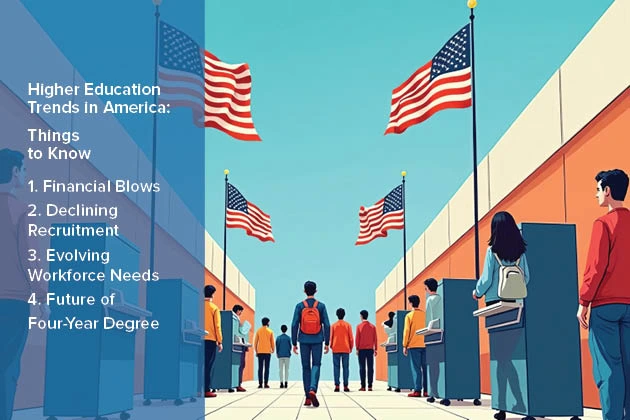
Just a few years ago, American campuses were riding a boom in international enrollments; a stream of global talent enriching classrooms, research labs, and the cultural vibrancy of campuses throughout the country. A news report mentioned that during 2024-2025, US colleges and universities hosted 1.18 million international students, about 6% of total enrollments, making the country a top global destination for higher education. Yet beneath that headline success lies a growing tremor. As institutions plan 2025 admissions, nearly 85% of U.S. universities now cite visa barriers and tougher immigration policies as a major concern — up sharply from 58% the year before.
With The Silicon Journal, readers can enhance their skills and knowledge with updated and crucial information regarding various industries. Be it education or technology, The Silicon Journal delivers quality and well-researched articles, news, and blogs spanning industries and trends reshaping those industries for readers to keep engaged and informed.
From Boom to Crunch: The New Reality of U.S. University Recruitment
In 2025, the number of foreign students at US universities significantly declined. According to a recent survey, there is a 17% decline in new international student commencements, one of the sharpest declines outside the COVID years. Meanwhile, graduate-level enrollments of international students faced a jolt, even as many institutions scramble to diversify outreach to other countries. According to a report by The Economic Times, more than 85% of American universities confirmed immigration and visa barriers as their key challenge in recruitment efforts.
This slide in enrollment doesn’t just shrink classrooms; it ripples through budgets, academic ecosystems, and community economies. As we evaluate the higher education trends in America, we have identified that international students contributed nearly $55 billion to the US economy and supported thousands of jobs in 2024 alone. As that pipeline constricts, universities must reinvent how they recruit, how they remain financially stable, and maintain academic excellence.
Yet the impact is not purely financial. With fewer global voices on campus, the diversity of ideas, cross-cultural collaborations, and international perspectives that once defined American higher education face erosion. Simultaneously, shifting societal expectations, greater cost sensitivity, demands for inclusive curricula, and hybrid learning models are reshaping the domestic student market. In a high-stakes moment for American higher education, institutions must adapt fast or risk losing global relevance and financial viability.
In this shifting environment, institutions — and perhaps the nation — must ask: will the U.S. remain the premier destination for global scholars, or will policy and uncertainty reroute talent elsewhere?
Trends to Observe in US Higher Education in 2025
2024 remained an eventful year for the American higher education sector. The presidential election ushered in a new administration with an agenda aiming to reshape the public sector, including higher education. With declining trust in US higher education, the National Education Foundation has initiated discussions to evaluate how the sector can rebuild trust. The following are the top three trends of the sector that have been reshaping the scenario of US higher education in 2025:
1. Addressing Financial Blows
According to a Deloitte survey, more than 40 colleges have closed in the United States since 2020. Throughout the sector, educational institutions encounter various degrees of financial issues. Since the beginning of 2024, an average of one college each week has announced its closure or merger with another institution. Around 20 colleges closed in 2024, and around 9 colleges have announced closure in 2025. The financial strain of several colleges and universities has compelled them to adopt a more centralized approach to managing resources, including the evaluation of strategic budgets and more. Machine learning, predictive analytics, and generative AI are enabling leaders to understand trends and make recommendations to build trust.
2. Declining Recruitment
U.S. college recruitment challenges significantly include a drop in student enrollment. The enrollment numbers have decreased in the higher education sector of the country. During the 2025 fall semester, new international student enrollment at US institutions dropped by 17%, mainly because of government policies and visa restrictions. According to a CNBC report, due to the Trump administration’s changes to the student visa policy, the higher education sector witnessed a sharp decline in student recruitment.
3. Evolving Workforce Needs
According to the American Council on Education (ACE), nearly 50% of Chief Academic Officers have been in their current position for three years, and 30% of them plan to retire within the next five years. These statistics indicate the challenges institutions face in maintaining stable leadership in key administrative roles. The average turnover rates in top leadership roles over the past decade hit an unprecedented high of 21.4%. To cope with this challenge, educational institutions are embracing the appointment of multiyear interim roles in higher education.
The roles and responsibilities of university staff are also rapidly evolving, with the spread of AI capabilities. By delegating the work of personnel to AI, universities are cutting the cost of administrative work in this sector. As the tech landscape changes rapidly, universities must adapt to thrive.
4. What’s in Store for the Future of the Four-Year Degree?
In response to the rapidly evolving political, economic, and social landscape of the USA, some institutions have shifted their focus to new credentials. This resulted in several alternative pathways to accelerated degree programs, favoring students, their families, and employers for their cost-effectiveness. These pathways have transformed the traditional four-year college model, enabling higher education institutions to expand enrollment programs, integrate experiential learning opportunities, and develop competency-based degree programs. The Deloitte study reveals that only 47% Americans believe that a four-year degree is worth pursuing without loans. However, the figure dropped to 22% when the loan is included. To combat the situation, institutions will need to personalize and optimize educational experience in a manner that balances human capabilities and technology.
How are Immigration Policies Influencing the Future of Foreign Students in the USA?
The Trump administration abrogated policies that protected a few locations from immigration enforcement, including schools. With the U.S. Immigration and Customs Enforcement agents as a threat to immigrants, undocumented students are in anxiety. Some states in the country are creating extreme barriers to higher education by limiting access to in-state tuition for undocumented students. For instance, the Texas state legislature has introduced nine bills to repeal immigrant students’ access to financial aid and in-state tuition.
The impact of immigration policy on education moves beyond restricted access to in-state tuition. In Florida, where, depending on immigration status, the state legislature has introduced an additional bill that restricts undocumented students’ ability to attend higher education institutions at all. Limited access to higher education opportunities limits students’ chances of securing high-paying jobs and pushes more immigrant youth into the workforce at an earlier age. This raises concerns about labor exploitation and unsafe working conditions for minors.
A lack of access to educational opportunities can economically push back the current and future generations, negatively impacting state and local communities by limiting the earning potential of newcomers as taxpayers and consumers. According to the research of the American Immigration Council, Texas could lose $216.9 million in additional spending power annually and $244.4 million in wage earnings.
Denying students education based on their immigration status could be an abuse of the principles of progress, equality, and the belief that every child deserves a future.
Related Articles


Recent Articles




Latest Issue