A Sneak-Peak Into the Upcoming Trump Administration Immigration Rule
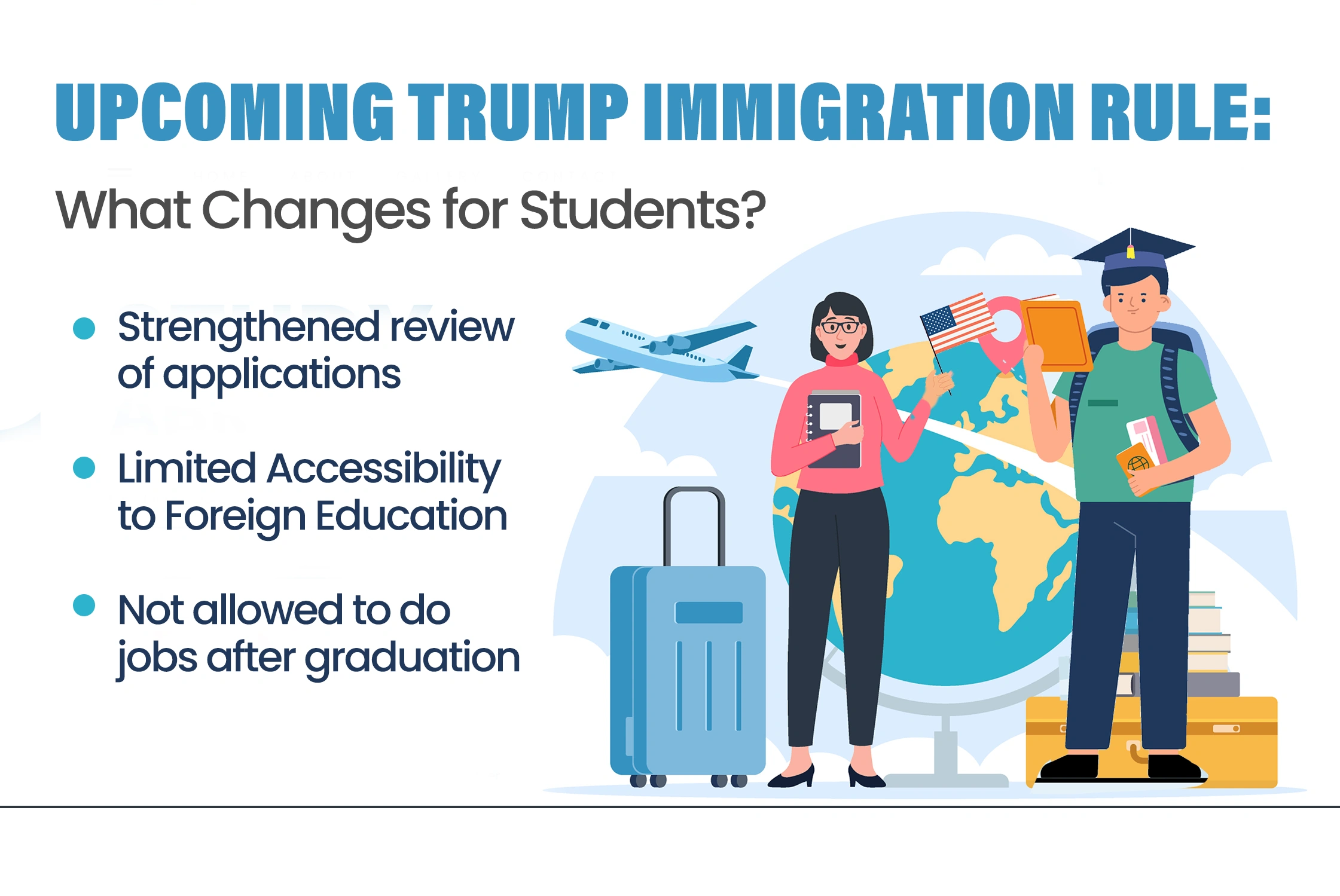
As confirmed by the White House, on December 16, 2025, the honorable U.S. President Donald Trump signed a Proclamation that strengthened entry restrictions on nationals from countries with severe drawbacks in information-sharing, vetting, and screening to protect the Nation from national security and public safety threats. The upcoming trump administration immigration rule has been designed to impose complete restrictions and entry limitations on nationals from 12 high-risk countries established under Proclamation 10949: the Republic of the Congo, Eritrea, Afghanistan, Iran, Burma, Haiti, Equatorial Guinea, Sudan, Libya, Yemen, and Somalia.
The President’s Take On the Immigration Rule
The U.S. President, while reflecting on his immigration rule, commented, “It is the policy of the United States to protect its citizens from foreign nationals who intend to commit terrorist attacks, threaten our national security and public safety, incite hate crimes, or otherwise exploit the immigration laws for malevolent purposes. The United States Government must ensure that admitted aliens do not intend to threaten its citizens; undermine or destabilize its culture, government, institutions, or founding principles; or advocate for, aid, or support designated foreign terrorists or other threats to our national security.”
He clarified that during his first admission as the President of the United States, he restricted the entry of certain foreign nationals into the country to prevent public safety and national security threats from reaching the country’s borders. He reinstated these policies in Executive Order 14161 of January 20, 2025 (Protecting the United States From Foreign Terrorists and Other National Security and Public Safety Threats), and Proclamation 10949 of June 4, 2025 (Restricting the Entry of Foreign Nationals To Protect the United States From Foreign Terrorists and Other National Security and Public Safety Threats).
By following the directives of Executive Order 14161, the Secretary of State, in coordination with the Attorney General, the Director of National Intelligence, and the Secretary of Homeland Security, identified countries across the world that have severely deficient vetting and screening information as to warrant a complete or partial suspension of the admission of nationals from countries pursuant to section 212(f) of the Immigration and Nationality Act (INA), 8 U.S.C. 1182(f).
In response to all the reviews and considerations regarding the 10949 proclamation, Trump indicated further restrictions on national entry. In his views, “I have decided — as described in sections 2 and 3 of this proclamation — to continue to impose and modify the limitations outlined in sections 2 and 3 of Proclamation 10949 on the entry into the United States by certain classes of foreign nationals. Also, I have decided — as described in sections 4 and 5 of this proclamation — to impose the limitations set forth below on the entry into the United States by certain other classes of foreign nationals.”
Impact of New Immigration Rule on Immigrant Students and the US Employment Rate
Foreign students’ presence undeniably shapes national unemployment rates. Today’s shifting economic landscape is having a powerful impact on the job prospects of immigrant students participating in the Optional Practical Training (OPT) program. During spring 2025, more than 4,700 student visas were rigorously reviewed, leading to the sudden cancellation of visa appointments and reversal of approvals. Students started to worry about profiling and surveillance, and how this could affect their education and employment in the country. The shift in foreign policy has implications that go beyond individual applicants. For instance, the Caribbean sent more than 86,000 students to US institutions. But these applications are now at risk, pushing students to shift to other countries for further education.
These changes affected talent flows, soft power influence, and academic cooperation. Widespread delays, unclear vetting processes, revoked visas, and growing student anxieties make the US an unreliable education destination.
A recent study by the National Foundation for American Policy (NFAP) highlights how foreign students’ effect on unemployment rates changed the scenario of U.S. employment, bringing fresh talent and energy into the workforce.
Navigating immigration regulations is challenging for students coming from foreign countries. Students from OPT programs in the USA can be negatively affected by changes to immigration laws and visa requirements. The political atmosphere surrounding immigration reform amplifies uncertainty and complications in the job search process for foreign students.
An Insight into the 10949 Proclamation
Thorough screening and vetting in immigration and visa processes play a vital role in safeguarding citizens from terrorist threats and ensuring national security. These protocols enhance the ability to detect foreign nationals who may be a potential threat to national security. It is the United States’ policy to take all necessary and appropriate steps to encourage foreign governments to enhance their identity management and information-sharing protocols and to share their threat and identity information with the vetting and screening systems of the U.S.
By strengthening the Proclamation, Trump ensured national security with the following restrictions:
1. The proclamation continues to restrict and limit the entry of nationals fromthe 12 high-risk countries under Proclamation 10949.
2. It adds full restrictions and entry limitations on 5 additional countries, which include Mali, Niger, Burkina Faso, Syria, and South Sudan.
3. It completely restricts Sierra Leone and Laos, previously subject to partial restrictions.
4. Imposes complete restrictions and entry limitations on individuals holding Palestinian Authority-issued travel documents.
5. 15 additional countries are partially restricted, including Côte d’Ivoire, The Gambia, Malawi, Angola, Antigua and Barbuda, Dominica, Mauritania, Gabon, Tanzania, Nigeria, Benin, Zimbabwe, Tonga, and Zambia.
6. The Proclamation continues partial restrictions on nationals from 4 of the 7 original high-risk countries, which include Cuba, Burundi, Togo, and Venezuela.
7. It includes exceptions for lawful permanent residence, visa categories like athletes and diplomats, existing visa holders, and individuals serving U.S. national interests.
A Glimpse at the DC Circuit Court’s Decision on OPT
On October 4, 2022, the DC Circuit Court Decision on OPT legally upheld the legality of the F-1 OPT and STEM OPT programs. It ruled out the authority of the Department of Homeland Security (DHS) to allow international students to work in the U.S. after their graduation, thinking it a justified extension of the F-1 visa’s purpose. It affirmed previous rulings, allowing students to gather work experience directly after their studies. However, with the DC Court’s decision on the case of Washington Alliance of Technology Workers (WashTech) v. Department of Homeland Security (DHS), the court limited students’ work authorization for practical training.
The H-1B Visa Implications on the Unemployment Rate
Concerns related to the long-term employment prospects of F1 OPT students in the US have changed dramatically in view of the recent developments in the immigration policies, including changes to the H-1B visa program. As Trump attempted to reduce immigration through his rigorous immigration policies, government data shows that U.S.-born workers have not experienced any benefit from the decline in immigration. According to the U.S. Department of Labor, the unemployment rate for U.S.-born workers increased to 4.3% in November 2025 from 3.9% in November 2024. Unemployment rate for all workers has also soared to 4.6% in November 2025 from 4.1% in January 2025.
Labor economist and NFAP Senior Fellow Mark Regets mentioned in an interview, “I believe that the reported increase in total U.S.-born employment is a statistical illusion. Census projected an increase in the population of the U.S.-born over age 16 of just 1.4 million between 2024 and 2025, yet the BLS Household Survey estimates show an increase of 3.8 million U.S.-born workers just between January and November, an implausibly high figure.”
As a well-known business media publication in the USA, The Silicon Journal is committed to covering all that’s happening in the country’s political, social, and economic landscape that could influence the job market and business world. With news like changes in immigration policies and more, it tends to keep the reader on the edge of knowledge exposure.
Related Articles


Recent Articles




Latest Issue