The Fluctuating USA Tariffs: Impact on SMBs
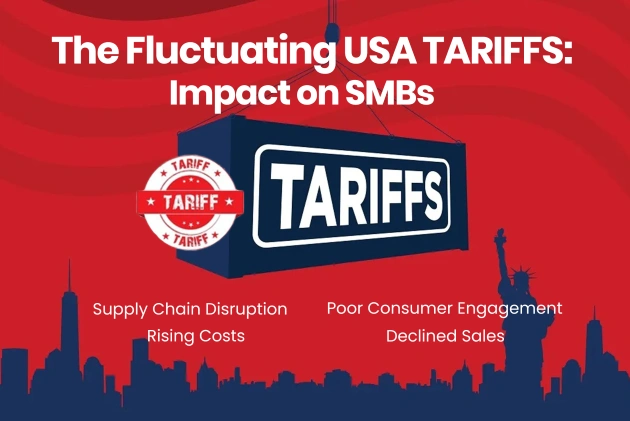
In the last two years, the USA's tariff policy has shifted from an occasional trade leverage to a central economic force, especially for small businesses navigating constrained resources and thin profit margins. What began as protective levies in 2025 quickly became a broad cost burden, with small business importers facing a surge in monthly tariff payments compared to pre-tariff levels. With more insights on how tariffs affect small businesses in the USA, this article delineates the scenario of trade tariffs and their business implications in the country.
Tariff Waves of 2025
Under the reign of Donald Trump, the United States has witnessed a wave of tariffs since February 1, 2025, that not only affected dozens of countries but also influenced domestic businesses in the country. An economic analysis reveals that since April 2025, the administration’s trade policies are taking a heavy toll on Main Street, with small business importers paying $25,000 more every month in tariff costs. According to Yahoo Finance, the tariff announcement on the administration’s Liberation Day accelerated a sharp rise in duties collected from American businesses.
Since early 2025, escalating tariff policies in the United States have reshaped the operating landscape for small business owners — tightening margins, disrupting supply chains, and challenging growth strategies. Small businesses aren’t fringe players; they account for nearly 97% of U.S. importers and handle roughly a third of total import value into the country. What began as protective levies in 2025 quickly became a broad cost burden, with small business importers facing a surge in monthly tariff payments compared to pre-tariff levels. These added expenses aren’t minor accounting annoyances — they represent fundamental strategic pressures that influence pricing, hiring, and even long-term viability.
Tariffs and Small Businesses in the USA
As history reflects, small firms thrive on efficient supply sourcing and predictable cost structures. However, when tariffs burlap up 25% extra on key imports, from fashion accessories to electronic components, the result is a squeeze on margins that disproportionately affects small enterprises competing with multinational competitors. The scenario is equally straining for non-importers as well. As tariffs on intermediate goods like electronics, steel, or apparel push production costs higher for small manufacturers and craft businesses that depend on global supply chains, they face the ripple effect of tariff amplification.
Unlike large companies that can negotiate high pricing or diversify global suppliers, small business owners have limited resources, exposing them to abrupt cost hikes on input. The knock-on effect is tangible: some proprietors are forced to pass costs to consumers, delaying expansion plans, cutting labor hours, or shelving investment in innovation altogether.
Center for American Progress reveals that between April and September 2025, many small firms have collectively paid tens of thousands of dollars per business in tariff costs, which could exceed half a million dollars in 2026 if this tariff trends persist. This policy debate translates into real financial strain that forces retail owners, boutique manufacturers, and import-dependent service firms to rethink pricing, staffing, and investment plans. In response, some have no choice but to raise prices, potentially dampening demand in an already cautious consumer market, while others reluctantly absorb costs that shrink profits.
Tariff Uncertainty has also rippled through consumer behaviour. When businesses raise prices to offset duties, price-sensitive customers may retreat by reducing sales and compelling entrepreneurs to get creative with inventory and pricing strategies. Supply chain disruptions double these pressures as enterprises reevaluate sourcing footprints and struggle with regulatory paperwork to comply with evolving trade rules. As a result, small business leaders now factor tariff risk into every strategic decision, from budgeting and product designing to international partnerships.
How AI Helps SMBs Navigate the Shifting Tariff Landscape in 2026
Amidst the chaotic tariff environment in the country, small businesses could leverage tech-powered business tools like AI tools to ensure improved productivity and enhanced sales. Below are some of the best AI tools for marketers in 2026 to cut through tariff chaos.
1. Dialpad AI
AI tools can give small businesses a real leg up by augmenting small teams with capabilities to ensure efficient work. As small businesses in the USA are grappling with tariff volatility, Dialpad’s Agentic AI helps them amplify their capabilities by working as real-time human assistants. This tool can effectively enhance business productivity, enabling it to navigate complexities with improved capabilities.
2. Seventh Sense
E-mail marketing could help SMBs draw more consumer engagement amidst the tariff chaos. Seventh Sense is designed to help businesses optimize e-mail marketing campaigns in conjunction with HubSpot and Marketo. By reaching each recipient’s optimal engagement time, this tool tailors delivery for individual preferences.
3. Flick
Social media content creation is gaining momentum with Flick. This all-in-one scheduling, analytics, and hashtag tool simplifies the process of managing and growing social media accounts for small businesses. By analyzing the market environment, this tool helps curate new content ideas to attract consumers.
4. Clari
Clari is dedicated to improving revenue predictability, ideal for small businesses looking for solutions to generate and predict sales in times of uncertainty. Through auto-capturing, this tool captures valuable customer data to identify new opportunities.
5. Jasper
An AI-powered writing assistant, Jasper, uses ChatGPT-3 and 4 to generate high-quality content for specific formats. This tool assists in blogging and content marketing to echo a brand’s unique voice. By addressing the tariff turmoil, bloggers and content makers in SMBs can cater to the audience’s knowledge needs to ensure long-term engagement.
With The Silicon Journal, we are catering to the diverse needs of business enthusiasts, looking for updated information on the business world and the factors influencing it. Our articles, blogs, and news are designed to address all your business needs.
Related Articles


Recent Articles


Latest Issue