Ways Globalization Unlocked Benefits for the US Consumers
Jan Aart Scholte, in his book ‘Globalization: A Critical Introduction,’ has elucidated globalization: ‘as a reconfiguration of social geography marked by the growth of transplanetary and supraterritorial connections between people.’ Several researchers have interpreted globalization to mean so many things that its original meaning seems to have been lost. However, the debate over this cluster of phenomena has gained momentum due to advances in technology, access to information through satellite communication, modern transportation, the introduction and adoption of the internet, and cable networks.
As your guide to understanding globalization and its impact on consumer consumption and technological adoption, this article by The Silicon Journal examines what globalization encompasses and how it benefits U.S. consumers. The Silicon Journal, as an emerging business media publication, covers almost all aspects of the global business environment, including globalization.
Apprehending U.S. Globalization: A Multifaceted Phenomenon
Globalization is a multifaceted approach that encompasses economies, cultures, environment, governance, sovereignty, international relations, religion, and more. It is often defined as a process of growing cultural differentiation and functional integration in the world economy, characterized by accelerating interdependence across the globe. Globalization is about the nation-state coming under pressure from the rise of transnational phenomena.
The United States of America, as one of the most developed countries in the world, has contributed to the advancement of globalization, influencing international trade and consumer behavior throughout the nation. With rapid advancements in mobile technology, cell phone adoption in the United States has changed the way goods and services are sold and consumers purchase products or services. As the internet made its way through smartphones, shopping and online browsing came to our fingertips. This shift in consumers’ purchasing behavior was no less than a revolution.
America actively molds the modern global economy, championing institutions and rules while seeing globalization as a powerful tool to boost its corporations and strengthen its geopolitical standing. During the 20th century, the world witnessed a golden era of globalization under America’s dominance. It is during this time that 1990’s global GDP of 38% rose to 57% in 2018. The United States signed the North American Free Trade Agreement in 1992 and helped establish the World Trade Organization in 1995.
In terms of expanding international trade and foreign direct investment, globalization may seem quite abstract. Consumers’ shift toward buying products from foreign countries at a hefty price influenced international trade. Organizations willing to invest in a foreign country and expand their business there were often denied access or allowed access only to specific economic sectors. The American Free Trade Agreements set a standard that changed the scenario of international economic relations. Except for NAFTA, no other agreement had such a robust relationship with other countries across various levels of development among the United States, Canada, and Mexico.
Globalization: How it Benefits the U.S. Consumers?
Today, consumers enjoy a wider array of choices than ever before, all thanks to the sweeping influence of globalization. The internet has unlocked a world of possibilities, letting people shop from their couches, discover new products, and access services from across the globe. In this article, we will dive deep into the ways globalization has shaped the experiences and advantages of U.S. consumers.
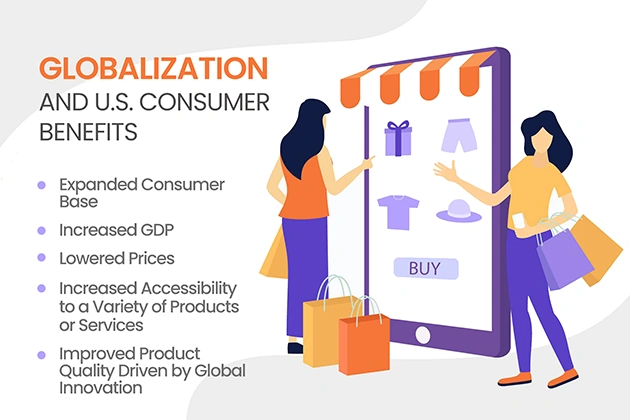
1. Expanded Consumer Base
An increased business consumer base was one of the biggest impacts of globalization. By unlocking the door to new markets, businesses are allowed to expand their customer base globally, catering to the varied needs of each market and winning consumer trust through improved consumer services.
2. Increased GDP
A rising GDP = more jobs, increased spending power, higher incomes, greater access to goods and services, and improved public services. By fostering an overall economic well-being, the globalization-driven increase in GDP aimed to enhance consumer experience in the country. According to the U.S. Bureau of Economic Analysis, the U.S. GDP increased at an annual rate of 4.3% in the third quarter of 2025, indicating increased consumer spending and exports.
3. Lowered Prices
Globalization has dramatically transformed the consumer landscape by making a variety of products and services available at an affordable price. While increasing competition and enabling companies to achieve economies of scale through global production, this phenomenon enables lower prices for consumers and increased spending.
4. Increased Accessibility to a Variety of Products or Services
As the U.S. has a remarkable position in global trade, by pushing its boundaries, the country has entered several foreign markets. This allowed the global businesses of the country to expand their service and product delivery according to the changing needs of the global consumers, exposing them to the accessibility of a variety of products or services.
5. Improved Product Quality Driven by Global Innovation
As we measure globalization benefits for American consumers, improvements in product quality driven by global innovation have emerged as one of the most significant benefits of the phenomenon. With growing innovation across the globe, consumers can now purchase quality products from any country while sitting in the comfort of their home.
Related Articles


Recent Articles





Latest Issue