Redefining CEOs’ Responsibilities With AI
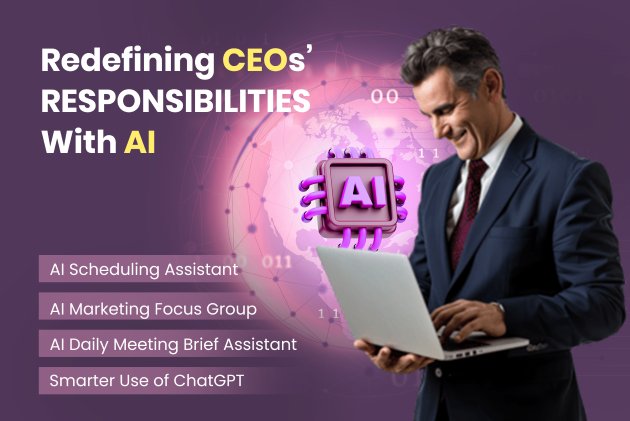
Executives stand at the forefront of business operations, growth, and success in a super-competitive business environment. With technological developments radically transforming the global business landscape, executives, such as Chief Executive Officers (CEOs), are leveraging various tech-powered tools to optimize business performance and strategic decision-making for a competitive edge. As artificial intelligence (AI) continues to rewrite businesses’ success stories, CEOs are adopting advanced business AI tools in the USA to rewrite their own.
How AI Tools Are Rewiring C-Suite Leadership for Tangible Outcomes
In boardrooms from Silicon Valley to Main Street, something remarkable is happening: CEOs are no longer cautiously exploring artificial intelligence — they are architecting it into the backbone of business performance. After years of experimentation, AI has evolved from a speculative advantage to an operational imperative. A McKinsey & Company survey reveals that 88% organizational people confirmed using AI in at least one business function. 23% of respondents report that their organizations are scaling an agentic AI system somewhere in their enterprises. This underscores how deeply CEOs are embedding these tools into company strategy rather than treating them as one-off projects.
At its essence, AI gives CEOs a quantum leap in actionable insight. Automated analytics engines sift massive datasets in seconds, revealing patterns and opportunities that previously took weeks of manual work.
More than half of business leaders are actively leveraging AI tools to streamline operations and enhance strategic outcomes, from process automation and customer engagement to risk management and talent optimization. Yet the conversation at the C-suite level isn’t just about adoption—it’s about impact. CEOs are increasingly investing in AI software that doesn’t merely execute tasks, but augments decision-making at the highest levels. Once reserved for specialist teams, AI tools are now front and center in executive strategy discussions.
Consider the evolution of AI tools in business: intelligent automation reduces repetitive workloads, allowing human workforces to focus on creative and strategic priorities that drive revenue. A Forbes report shows that AI-powered analytics platforms crunch vast datasets instantaneously, transforming what would be weeks of manual work into real-time insights that inform investment choices, product direction, and market expansion. For CEOs, these tools are not productivity hacks—they are foundational levers that elevate operational performance across every function.
AI’s influence on business operations is both broad and deep. For instance, Generative AI software facilitates strategic content creation, internal reporting, and market research with speed and accuracy, which was previously attainable. Predictive analytics models help CEOs anticipate customer behavior, pinpoint emerging trends, and allocate resources more effectively. Meanwhile, AI-powered cybersecurity tools constantly scan and neutralize threats, ensuring robust protection for digital assets. All of these advances converge to create a more responsive, adaptive, and insight-driven organization.
According to Forbes Advisor surveys, businesses are deploying AI across areas as diverse as inventory management (40%), customer service automation (56%), and fraud detection (51%). These deployments don’t just streamline operations; they redefine competitive advantage — enabling CEOs to make faster, data-driven decisions with greater precision.
However, the story goes beyond efficiency. CEOs are turning to AI to reshape organizational performance. They leverage predictive models to spot revenue opportunities, accelerate product development cycles, and mitigate risks. Companies that strategically integrate AI tools report measurable improvements in operational performance and customer satisfaction, from chatbot platforms and virtual assistants to advanced business intelligence suites.
Many leaders believe that prioritizing AI in software selection is not optional. 79% of businesses consider AI as a key criterion when choosing tech solutions, reflecting a growing consensus that AI adoption is core to long-term success.
CEO Playbooks in the Age of AI: Turning Data into Decisions
Artificial intelligence has rapidly shifted from a futuristic concept to a CEO’s everyday decision engine, fundamentally transforming how organizations operate and compete. AI software for executives is not only turning data into insights but also empowering CEOs to remain at the forefront of business decision-making. Tools like predictive modeling platforms help leaders anticipate customer churn, optimize supply chains, and adjust pricing strategies in real-time. Meanwhile, AI-powered customer relationship systems are reshaping how businesses engage clients, personalize experiences, and track engagement metrics with unprecedented clarity.
Yet, as CEOs push these powerful tools deeper into operations, they also confront cultural and organizational challenges — from change-management friction to ensuring ethical deployment. Nonetheless, for forward-thinking CEOs in 2026 and beyond, AI has become less of a luxury and more of a strategic foundation — one that augments human judgment, accelerates performance metrics, and redefines what’s possible in competitive markets.
AI for CEOs: From Operational Efficiency to Executive Intelligence
CEOs are not just delegating tasks to algorithms; they’re reshaping organizational processes. AI-enabled sales optimization tools help executive teams fine-tune pricing strategies and improve conversion rates, while dynamic risk detection systems continuously monitor threats to business continuity. Leaders are also deploying AI for workforce analytics, gaining nuanced insights into employee performance, retention risks, and talent development—turning data into actionable human capital strategies.
Even with varied results in ROI and adoption maturity, a clear trend has emerged. Executives who strategically embed AI into business models outperform peers who treat it as an experiment. In markets marked by uncertainty, AI tools provide CEOs the foresight to anticipate challenges, the agility to pivot with precision, and the confidence to lead with data-driven clarity.
Top 10 AI Tools Every CEO Must Use in 2026
For today’s CEOs, artificial intelligence has transcended novelty and moved into the realm of core business infrastructure. Below are the 5 best AI tools for CEOs to adopt in 2026.
1. AI Scheduling Assistant
The majority of the CEOs spend dollars on keeping a scheduling assistant who helps them schedule meetings. But this can sometimes be challenging for CEOs to work with human assistants if the requirements are not well communicated. This is where the AI scheduling assistant comes into the picture to schedule calls and meetings with clients and partners. This AI-powered virtual assistant works in line with the CEOs’ Google calendar to check on their availability and schedule meetings accordingly. It also shares this information and the meeting link with the respective clients and partners that CEOs would interact with. The assistant would also get confirmation from them to book a meeting call.
2. AI Marketing Focus Group
This AI marketing tool provides marketing ideas in response to your own ideas by optimizing them related to messaging and launches. In the tool, CEOs send messages to the marketing avatar regarding his/her marketing requirements, and the tool optimizes the initial ideas by passing them to three avatars and providing a final holistic marketing idea according to the CEOs’ specific requirements.
3. AI Daily Meeting Brief Assistant
With an AI daily meeting brief assistant, CEOs receive the details of their daily routines at the beginning of the day, such as what tasks they have to perform on that day, who they are going to meet, and others. It automatically records, transcribes, and summarizes meetings to identify action items and draft follow-up emails. By integrating with digital communication platforms like Teams, Zoom, and Google Meet, this business tool can transform raw conversations into actionable insights for CEOs to make informed business decisions.
4. Google NotebookLM for Podcast-Style Learning
Google NotebookLM is an extremely powerful business tool that allows CEOs and other users to convert complex and dense documents (PDFs, website links, and YouTube videos) into personalized “Audio Overviews,” which sound like podcasts. This tool can serve as a “company brain” for CEOs by helping them transform hours of reading into concise, 10-15-minute-long, two-host audio conversations.
5. Smarter Use of ChatGPT
CEOs can smartly use ChatGPT by transitioning from using it as a simple search engine to leveraging it as a strategic sounding board. This helps them enhance decision-making, boost productivity, and streamline operations by analyzing complex data or drafting executive communications.
With The Silicon Journal, business personnel, entrepreneurs, aspiring leaders, and business management students can stay informed about the latest shifts and trends influencing the global business environment. Our articles, blogs, and news are carefully crafted after rigorous research to ensure every piece of information shared is authentic.
Related Articles


Recent Articles




Latest Issue