White House Drug Policy Meeting 2026: Why Is It Significant?
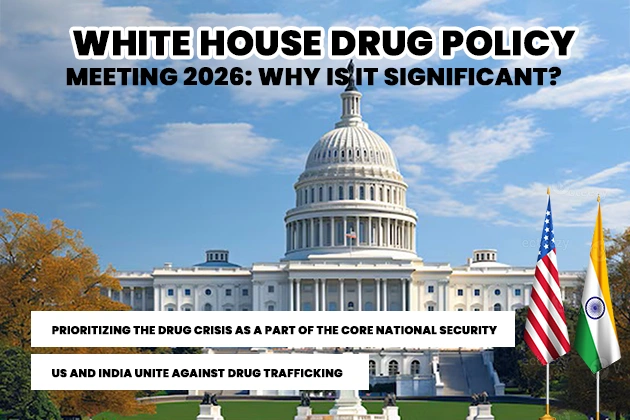
The recently hosted inaugural meeting of the US-India Drug Policy Executive Working Group in Washington, D.C., brings to light the shared and enduring commitment of both countries to addressing the global drug challenge. The White House Drug Policy Meeting 2026 is a testament to US President Donald Trump and Indian Prime Minister Narendra Modi’s unwavering commitment to strengthening security cooperation and eliminating narco-terrorism.
This meeting was inaugurated by The Office of National Drug Control Policy’s (ONDCP) Director, Sara Carter, from January 20-21. As informed by the Ministry of External Affairs, the Ambassador of India to the United States, Vinay Kwatra, mentioned that India has given the topmost priority to addressing the threat posed by narcotics trafficking and diversion of precursor chemicals. Additionally, the country also prioritized balancing effective enforcement with the fostering of legitimate trade. The Narcotics Control Bureau’s Deputy Director General, Monika Ashish Batra, and the Executive Working Group, led by Debbie Seguin, ONCP’s Acting Deputy Director, worked with the Indian and the U.S. delegations to achieve measurable outcomes in advancing the critical counter-narcotics partnership.
This article from The Silicon Journal provides an insight into the Drug Policy meeting of 2026, aiming to delineate its significance in eradicating narco-terrorism. The Silicon Journal is committed to crafting stories and delivering compelling content with detailed insights on various business areas, political aspects, social, economic, and other influencing factors.
About The Narcotics Control Bureau of India
Founded under the Ministry of Home Affairs, the Narcotics Control Bureau (NCB) is India’s apex drug law enforcement agency. Committed to safeguarding the health and security of Indian society, NCB eliminates the wrath of narcotic drugs and psychotropic substances in its fight against drug trafficking and abuse. According to NCB’s Director General, Anurag Garg, “Our mission is multifaceted—ranging from intelligence gathering and enforcement to rehabilitation efforts and public awareness. We work relentlessly to strengthen coordination among central and state agencies and engage with international partners to ensure that India's borders remain impervious to the illicit drug trade.”
In recent times, the agency has taken some significant steps in eradicating drug-related crimes through focused operations, increased technological capabilities, and enhanced inter-agency collaboration. Working collaboratively with law enforcement agencies, all stakeholders, civil society, and common Indians, NCB is fighting against drug trafficking and drug abuse.
About the Office of National Drug Control Policy, USA
The Office of National Drug Control Policy, or ONDCP, is responsible for the development and implementation of the National Drug Control Strategy and Budget. ONDCP works to lead and coordinate America’s drug policy for the improvement of the lives and health of the American people. It coordinates across 19 federal agencies and supervises a $44 billion budget as part of a ‘whole-of-government approach’ to address pressing issues like addiction and drug overdose. This government body also offers hundreds of millions of dollars to help communities stay safe and healthy through the High Intensity Drug Trafficking Areas Program and the Drug-Free Communities Program.
Prioritizing the Drug Crisis as a Part of the Core National Security
As pointed out by Sara Carter, “The drug crisis is now a core national security priority. This Executive Working Group leverages the bilateral partnership to protect families while also supporting legitimate industries.” The White House Drug Policy Meeting was committed to fostering a healthier and safer future for both nations. Through this meeting, both countries committed to strengthening the bilateral cooperation to knock down the illegal production and trafficking of illicit drugs and their precursor chemicals that threaten communities.
According to the White House, the two nations also emphasized the salience of a ‘whole-of-government approach,’ which streamlines intergovernmental and interagency efforts. They collaboratively secure the pharmaceutical supply chain while also celebrating the success of their recent joint operation to disrupt illegal narcotic trafficking networks.
Official spokesperson of the Ministry of External Affairs of India, Randhir Jaiswal, commented on this meeting by stating, “India and the U.S. held the Inaugural Drug Policy Executive Working Group meeting in Washington DC (20-21 Jan 2026). Both sides reaffirmed their shared commitment to countering synthetic opioids, novel precursors, and misuse of digital platforms, while balancing effective enforcement with facilitation of legitimate trade."
US and India Unite Against Drug Trafficking
The United States and India have formed a drug policy partnership to fight narco-terrorism with enforcement and intelligence sharing. The US Drug Enforcement Administration (DEA) on February 4 unveiled the outcome of “Operation Meltdown,” a crackdown that shook more than 200 internet domains linked to illegal online pharmacies run by an India-based transnational criminal syndicate. As part of the India-US narcotic trafficking prevention, this partnership between the two countries has strengthened the global combat against fentanyl. Authorities emphasized growing US-India cooperation to stop drug trafficking, as fentanyl remains a key threat despite the reduced number of deaths due to its overdose.
Related Articles


Recent Articles



Latest Issue