Reaganesque Leadership: Exceptionalism in Free World Security
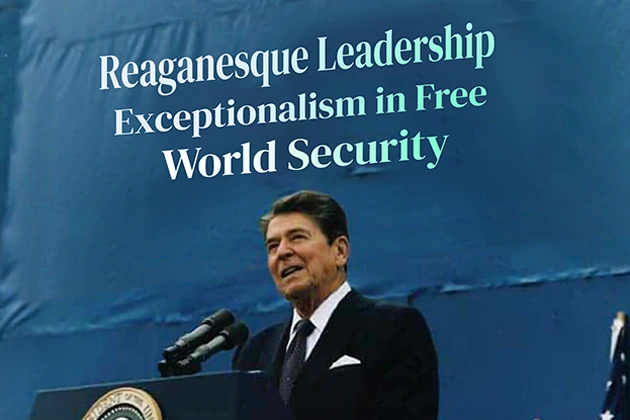
Ronald Reagan, the 40th President of the United States, exemplifies the essence of charismatic leadership merged with his personal vision and optimism, evincing a leadership style of his own. What we know as the Reaganesque leadership model is the embodiment of Reagan’s leadership, characterized by powerful communication, clear vision, connection-building, and optimism. With a communication approach extending beyond mere dissemination of information, Reagan is historically recognized as “The Great Communicator.” He prioritized a strong national defense and a robust national economy, low taxes, and individual freedom. While having a strong belief in this vision, Reagan emerged as the visionary leader for change.
While developing an understanding of the security threats likely to affect the Free World, this article delves deep into delineating the role of Reaganesque leadership in handling such critical global situations.
Delving into the Biggest Free World Security Threats
The Global Risks Report 2025 by the World Economic Forum revealed that over the last year, people have experienced escalated conflicts, extreme weather conditions driven by climate change, consistent technological advancements amplifying the spread of misleading or false information, and widespread political and societal polarization. As misjudgments by political and military actors remain high, limitations in optimism surfaced during this time. The report further clarified that we are living in “one of the most divided times since the Cold War.”
Reflecting on Reagan’s leadership during the Cold War, it becomes clear that his spirit of optimism could inspire today’s political leaders as they confront global security challenges. However, before we discover how, let’s discuss some of the pressing security issues threatening the free world's security.
1. Rising Geopolitical Conflicts
State-based armed conflict is charting at the top of the list of geopolitical conflicts threatening the free world's security. According to The Global Risks Report 2025, around 23% of respondents of the Global Risks Perception Survey 2024 have identified state-based geopolitical conflicts as the biggest geopolitical tension. Notably enough, the escalating tension between major powers, such as the United States, Russia, and China, is fueling state-based armed conflict since the Cold War. This power struggle manifests economic constraints, military posturing, rapid escalation of conflict, and a potential for miscalculation.
2. Gray-Zone Warfare
The ‘gray-zone” technique is another security threat that is hovering around the free world countries. Malicious and state actors are now deploying these tactics to a large extent. These are some hostile actions taken beneath the threshold of open conflict, such as election interference, sabotage, and attacks on critical infrastructure. Strategically ambiguous, these actions are engineered to cause disruption and ignore triggering a conventional military response. Such tactics are becoming an immediate threat to national security and business continuity.
3. Societal Polarization
As misinformation, or false content, continues to spread rapidly, driven by social media and artificial intelligence, it worsens political and societal polarization between and within countries.
4. Climate Change and Resource Scarcity
Not simply as a global issue, climate change is catalyzing other security issues across free world regions, such as natural disasters, involuntary migration, and resource scarcity. Growing environmental risks often amplify resource competition, regional instability, complex security challenges, and social disruption.
5. Deficiency in Technology Governance
AI is rapidly being deployed across military systems and in daily life across free world countries, outpacing global and national governance standards and creating a significant security risk. With AI-powered cyberattacks and autonomous systems, faster decisions are being taken during conflicts, leading to misinterpretation of information.
Reaganesque Leadership: An Exceptionalism Approach to Security
Built on the belief in American exceptionalism, Ronald Reagan has always put forward America’s global responsibility in ensuring security. The Cold War, being one of the prominent examples of the First World security threats, has been viewed by Reagan as not merely a geopolitical competition but a fundamental struggle between good and evil. He called the Soviet Union an “evil empire,” nullifying the notion that the US and USSR were morally equivalent.
With the “Reagan Doctrine,” he demonstrated his firm belief in America’s supremacy. According to the U.S. Department of State, the 1985 doctrine characterized the Reagan administration’s policy of supporting anti-communist insurgents. While addressing the State of the Union in 1985, Reagan called upon the American people and Congress to stand up to the Soviet Union - “We must stand by all our democratic allies. And we must not break faith with those who are risking their lives—on every continent, from Afghanistan to Nicaragua—to defy Soviet-supported aggression and secure rights which have been ours from birth.” Based on John Foster Dulles’ ‘roll-back” strategy from the 1950s, his directive confirmed that the U.S.’s policy toward the Soviet Union would be “to contain and over time reverse Soviet expansionism.” While maintaining firm pressure on the USSR, he also showcased his capability for pragmatic diplomacy. Reagan’s meetings with the Soviet leader Mikhail Gorbachev led to the elimination of nuclear weapons through the remarkable Intermediate-Range Nuclear Forces Treaty of 1987, establishing a perfect example of diplomacy in handling security threats.
The Silicon Journal is committed to delivering reliable and research-backed content that could influence the global business landscape, from politics to innovations. As a trusted provider of updated information concerning news, topics, trends, and business approaches, our business magazine stands as a testament to ethical and authentic media publication.
Related Articles


Recent Articles




Latest Issue