Decoding Taxpayer Behavioral Economics
According to behavioral economics, tax compliance is shaped by psychology as much as by law, where social norms and perceived fairness strongly influence whether people file and pay. Simple communication, timely reminders, clear instructions, and social-norm messages have repeatedly raised compliance in randomized trials, proving that small nudges can generate measurable gains in revenue.
With The Silicon Journal, you can stay informed about your tax payments, aspects related to your taxes, and everything that influences the US taxation system. Apart from taxation, our carefully curated articles and blog posts cover topics, trends, and technologies that influence several industries. Our business publication is committed to empowering readers with all relevant information that helps them stay ahead, from economic to political.
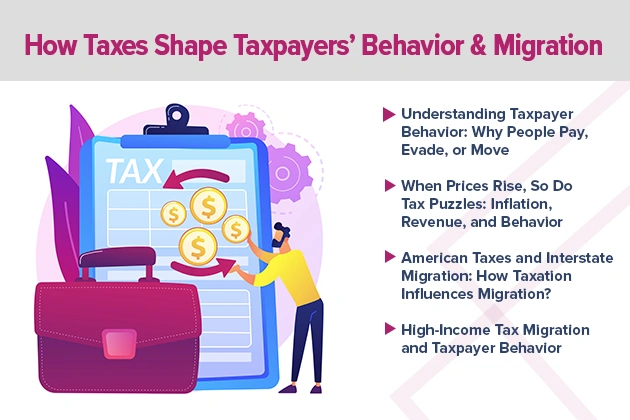
Understanding Taxpayer Behavior: Why People Pay, Evade, or Move
The Economic Deterrence Theory (the traditional “cops and robbers” model) posits that taxpayers are rational actors who weigh the costs and benefits of evasion. Compliance is influenced by the perceived likelihood of audits and the severity of penalties if taxpayers get caught.
On the contrary, Kirchler’s Slippery Slope Framework balances the influence of the tax authority’s power and the taxpayer’s trust in the authority and government. While a high-power and low-trust environment can lead to enforced compliance, a high-trust and low-power environment can foster voluntary cooperation.
According to the Fiscal Exchange Theory, taxpayers view the taxation system as a contract. In light of Taxpayer behavioral economics, this theory posits that taxpayers’ compliance is more likely if they perceive the system as fair and believe the government uses tax revenues wisely to deliver public goods and services they value.
Tax systems are social contracts, and when elites perceive the deal as unfair, they exercise mobility, including corporate inversion, legal emigration, or tax planning to restore after-tax returns.
Studies evaluating rich administrative data by the American Economic Association identify clear behavioral margins. According to these studies, top earners are more responsive to tax changes than average taxpayers, especially when earnings are concentrated, linked, or portable to business ownership. At the same time, careful empirical work shows aggregate revenue effects from migration are often smaller than simple theory predicts, because only a minority relocate, and others adjust in less extreme ways. However, behavioral nudges matter the most. Transparency, simplified compliance, and reputational costs can reduce avoidance and make in-country alternatives more attractive.
When Prices Rise, So Do Tax Puzzles: Inflation, Revenue, and Behavior
Inflation alters the incentives embedded in tax systems by inflating nominal profits, wages, and asset gains faster than policymakers can adjust rules. The mechanical result — bracket creep — increases effective tax burdens unless indexing or legislative fixes are applied, creating perceived fairness problems among taxpayers. According to a study by the International Monetary Fund, between 2021 and 2022, many OECD countries witnessed tax-to-GDP ratios shift as inflation amplified nominal tax bases. These shifts helped narrow budget deficits in several economies. Taxpayers react to perceived stealth tax increases. Some accept them as inevitable, and others reduce the labor supply or shift income across time and forms to preserve after-tax income.
Another study by OECD has mentioned that behavioral responses to this “hidden” revenue matter, as households delay realizations, reduce consumption, or seek tax-preferred forms of compensation to protect real income.
Firms and high-net-worth individuals face stronger incentives to optimize location and legal form of income, which can include cross-border migration when tax differentials are large. The recent empirical reviews by the American Economic Association highlight that while top-earner migration exists, its magnitude varies by policy design and institutional context, such as exit taxes, international coordination, and information sharing, which shape outcomes.
Behavioral economics complements this analysis by explaining why seemingly small administrative choices, including audit timing, framing of tax bills, or simplification of tax filing, change overall revenue and compliance rates. Automatic indexing of brackets and allowances, as implemented by some countries, prevents stealth tax hikes and stabilizes households' real burdens over time.
Inflation interacts with mobility. Rising nominal tax burdens can increase the perceived benefits of relocation for the wealthy, amplifying migration incentives when institutional exit costs are low. Policy responses that combine targeted enforcement, indexation of tax parameters, and international information exchange reduce perverse incentives without rolling back redistributive goals. Cross-border information sharing and common reporting standards have reduced options for hiding income offshore, changing the behavioral calculus for would-be migrants.
American Taxes and Interstate Migration: How Taxation Influences Migration?
The IRS data show that between 2021 and 2022, 26 US states experienced a net gain in income tax filers from interstate migration. Many factors contribute to an individual's or family’s decision to move from one state to another. Whether it is employment, geographic location, or proximity to family or friends, every year, millions of Americans move from one state to another. Although tax differentials may not be the primary reason for migration, they are one of the several factors that people consider while deciding their move.
High-Income Tax Migration and Taxpayer Behavior
High-income tax migration is an important behavioral margin for fiscal policy because top earners have both mobility and the means to restructure residency or income reporting. Yet empirical evidence finds that migration responses are real but often quantitatively modest for aggregate revenue — a non-trivial leak but not a fiscal catastrophe in most settings. Therefore, policymakers face tradeoffs: raising marginal rates can yield revenue today yet encourage avoidance or migration tomorrow, and nudges and enforcement can change choices at lower cost. Tax administrations that combine behavioral insights with data analytics tend to detect anomalies earlier and recover more revenue per dollar spent on enforcement. This piece maps evidence to policy now.
High-income individuals are extremely sensitive to tax increases, both internationally and within countries. Their behavioral responses of top earners are crucial as they generate a notable share of both state and federal tax revenues. According to IRS data, in tax year 2021, taxpayers with adjusted gross income of $200,000 or more generated $1.5 trillion in federal income tax payments, comprising 68% of total federal income tax collections. Additionally, taxpayers with an adjusted gross income of $1 million or above paid $824 billion or 37% of total federal income tax receipts.
Several studies identified that US states that introduced the income tax in the post-war period (1990-2010) lost more than 16% of their population within 20 to 30 years after the reform. When considering new revenue sources, lawmakers need to think beyond the short-term logic of taxation and account for the long-term impacts of increased tax burdens, particularly in an increasingly mobile economy.
In the post-pandemic era, taxes induce outmigration from high-tax states. However, correlation does not imply causation, and there might be other reasons for relocation. Recent evidence suggests that the connection between state income taxes and taxpayers’ decisions regarding where to work and live may be strong. Although not directly, taxes do affect migration, and policymakers need to consider this factor when implementing tax changes. This article also highlights that inflation and tax revenues influence taxpayers’ behavior in the United States. As discussed earlier, inflation boosts evasion, and taxpayers’ behavior shifts due to reduced purchasing power, perceived unfairness, and increased uncertainty. This prompts legal avoidance, influencing overall compliance and government revenue streams.
Related Articles


Recent Articles





Latest Issue