The Climate Cost of Doing Business in the U.S.
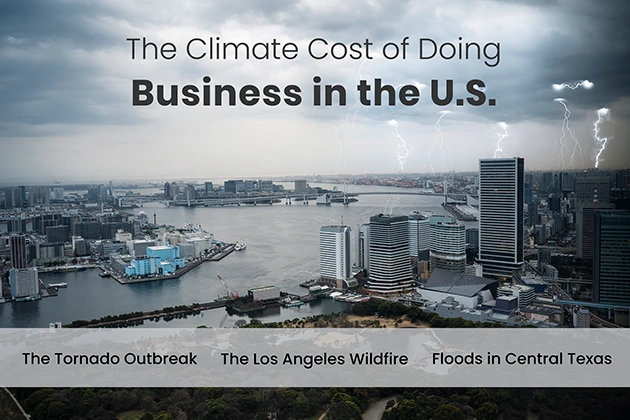
Weather conditions are no longer mere seasonal changes. Extreme climatic events have become as unpredictable as dice rolls, with the weather shifting dramatically as a wildfire wind. Cities and destinations vulnerable to extreme weather are facing economic consequences, posing an unpredictable threat of climate risk for businesses. According to the Commodity Futures Trading Commission’s 2019 report, “weather poses a risk to the stability of the financial system.” Infrastructure damage, rising sea levels, disrupted economies, and unpredictable storms are key weather-driven events reshaping the U.S. business landscape.
According to a CDP report, the world’s biggest companies face $1 trillion in climate change risks. Also, financial companies forecast a potential revenue of $1.2 trillion from low-emissions services and products. As the global average temperature has increased by 1.7°F from 1970 to 2023, temperatures in the contiguous United States and Alaska have also increased by 2.5°F and 4.2°F, respectively. Sectors, including agriculture, energy, health, travel, ocean and marine resources, transportation, and others, are affected by the shifting climatic conditions.
With the incredibly varied and complex phenomenon of weather, the implications that typhoons, floods, droughts, and hurricanes can bring to businesses are severe. This article from The Silicon Journal is a discursive piece that assesses the impacts of changing climate conditions on U.S. businesses. As an emerging business magazine in the U.S., The Silicon Journal has been shedding light on various phenomena, trends, and events influencing the U.S. business landscape.
Weather Events of 2025 that Changed the U.S. Business Risk Management
This year, the United States has experienced more than $14 billion in disasters, with over $100 billion in combined losses. The defining events of the year broke seasonal norms and highlighted emerging patterns that influenced how businesses plan for the coming years. The growing unpredictability in the occurrence of climatic events is forcing organizations to adapt faster than conventional risk management frameworks. The following are the five events that reshaped business risk management in the country.
1. The Los Angeles Wildfire
Wildfires are a common natural disaster in California, but they never occur in January. However, 2025 remained an exception for Californians. After a significantly warm and dry winter, the forest area encompassing Los Angeles ignited fires that rapidly spread into hillside neighborhoods. This event forced the city to deal with a disruption that usually occurs in late summer. It was not the fire behavior that remained challenging for businesses; it was the timing that compelled them to a sudden shutdown of operations. As wildfires can no longer be treated as a seasonal risk, organizations in the USA are adopting year-round monitoring, upgraded insurance strategies, and flexible continuity plans as essential tools.
2. The Tornado Outbreak
During the middle of March 2025, a strong storm system caused 115 tornadoes across the South and Midwest of the USA. It remained one of the most crucial early-season storms in the last few decades. These tornadoes severely affected many areas that were not known for frequent tornado activity, lacking the required shelter infrastructure of the common Plains. As reported by Forbes, “Warmer early-season temperatures helped fuel the instability behind this outbreak, but it also underscored a broader trend: severe weather footprints are expanding.”
This challenged the facility siting and workforce safety plans of businesses, which were designed by relying on historical climatology. In light of this event, organizations in the USA are working to upgrade their risk-aware operations through updated hazard models, severe-weather procedures across all locations, and regional preparedness.
3. Floods in Central Texas
July storms this year brought a deluge of rain to Central Texas, overflooding the drainage systems and causing catastrophic flooding. Due to the floods, highways were closed, freight movements were stalled, and other impacts occurred. The flooding was no mere rainfall; it was a challenge to the region’s existing infrastructure. Cities that are expanding faster than their stormwater systems and utilities are extremely vulnerable to compounding weather influences. In such a scenario, assessing the resilience of local infrastructure has become equally important as evaluating the resilience of their own facilities. From power reliability to transportation redundancy, everything became a part of business scaling.
Apart from these major events, low-risk probability calamities like the Gulf Coast Blizzard also carry cost burdens for businesses to plan the mitigation of hazards. To navigate the complex geographical and natural challenges, keeping businesses risk-ready is no longer a mere strategy but a necessity in the USA.
With the changing weather patterns in the U.S., such disasters would likely continue to occur all across the country. Hence, to operate under such environmental pressures, businesses are reimagining their operations and infrastructure to ensure resilience and sustainability. The climatic cost of doing business may be rising in the U.S., but natural calamities are helping organizations reshape operations and transform for the better.
Related Articles


Recent Articles



Latest Issue