Decoding Website Accessibility Standards (WCAG)
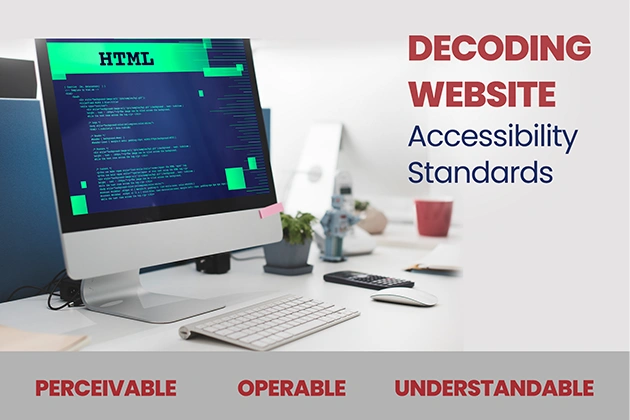
The inventor of the World Wide Web (WWW) and W3C Director, Tim Berners-Lee, has said, “The power of the Web is in its universality. Access by everyone regardless of disability is an essential aspect.” Website Accessibility Standards (WCAG) were developed to ensure inclusive web accessibility for persons with disabilities.
The Web was primarily designed for all, irrespective of people’s software, hardware, location, language, or ability. By meeting this goal, it becomes accessible to people with disabilities, including movement, hearing, cognitive, and sight disabilities.
As the web eliminates barriers to interaction and communication faced by many in this physical world, the impact of disability has radically shifted on the Web. However, a poorly designed application, website, technology, or tool can create barriers to accessibility, excluding diverse people from using the Web. This is where the concept of WCAG came into the picture to ensure an inclusive web accessibility for all.
Let us explore the world of the web and understand the concept and importance of web accessibility and its standards.
Looking Into the History of WWW
A British scientist, Tim Berners-Lee, first invented the World Wide Web in 1989. While working at CERN, he conceived and developed WWW in response to the growing demand for automated information-sharing between scientists in universities and institutes globally. The basic idea was to blend the evolving technologies of data networks, computers, and hypertext into an easy-to-use and robust global information system.
Tim proposed WWW in March 1989, which was later formalized as a management proposal in November 1990. His proposal explained WWW as a “hypertext project, in which a 'web of hypertext documents' could be viewed by 'browsers.’ Tim developed the code for his Web server on a NeXT computer. The designed WWW enabled access to existing information, and an early web page linked to information that was useful to CERN scientists.
Tim’s original Web Browser reflected his vision and consisted of many features of current Web browsers, with the ability to modify pages directly from the browser. It was Paul Kunz and Louise Addis who brought the Web server in the US online in December 1991. Since its launch in 1989, the WWW gradually become the global information medium that people can now access through computers, smartphones, and tablets that are connected to the Internet.
Understanding Web Accessibility
The term web accessibility refers to the design and development of websites, tools, and technologies to make them accessible for people with disabilities. Here, accessibility means that the technologies, websites, and applications are designed in such a way that specially-abled persons could perceive, understand, interact, and navigate with the Web and contribute to it as well.
Web accessibility includes almost all disabilities that can affect access to the Web. They are:
-
Cognitive
-
Auditory
-
Physical
-
Neurological
-
Visual
-
Speech
Apart from individuals with disabilities, web accessibility also benefits people who use devices with small screens and different input modes, those who are older with changing abilities, those with temporary disabilities, those with situational limitations, and those using a slow internet connection.
Website Accessibility Standards for Inclusive Web Accessibility
The W3C has published the Web Content Accessibility Guidelines (WCAG) to define ways to make web content more accessible to people with disabilities, older individuals, and these guidelines also improve usability for general users. Have a look at the guidelines below-
1. Perceivable
By perceivable, it means the information and user interface components must be presentable to users in a manner they can perceive. The web must provide alternatives for time-based media. For instance, for pre-recorded audio and pre-recorded video media, an alternative to time-based media should be provided with equivalent information for both media. Captions must be provided for all pre-recorded audio and video in synchronized media, except when the media is a media alternative text.
Adaptability is important for web accessibility. Information, relationships, and structures conveyed through presentation can be determined programmatically. Provided instructions for operating and understanding content should not rely solely on sensory characteristics, content should not restrict its view and operation to a single display orientation, and more. Content must be distinguishable by making it easier for users to see and hear, including separating foreground from background.
2. Operable
User interface components and navigation must be operable. For example, the web content must make all functionality available from a keyboard and provide users enough time to read and use the content. Developers must not design content in a way that could cause physical reactions or seizures. For example, web pages do not contain anything that flashes more than three times in one second, or motion animation triggered by interaction can be disabled unless it is needed for the information to be conveyed. Pages should be navigable by helping users find the content location and navigation easily. When it comes to smart e-commerce features in web content, its accessibility should be ensured through navigation, smooth checkout, accessible design, clear product info, and mobile optimization.
3. Understandable
By making text content readable and understandable, the information and operation of the user interface should be made apprehendable. From language to abbreviations, some mechanisms make web content readable. Web pages must appear and operate in predictable ways and help users avoid and correct mistakes.
4. Robust
Content must be robust enough to get interpreted by a diverse set of user agents, including assistive technologies. It should maximize compatibility with current and future user agents.
5. Conformance
To ensure your web page conforms to WCAG 2.1 guidelines, the conformance requirements, including conformance level, full pages, complete processes, non-interference, and accessibility-supported ways of using technologies, should be satisfied.
With The Silicon Journal, we are aiming to empower readers with all the trending business insights and news. As a reputable business media publication, our magazine covers a wide range of business topics, trends, technologies, innovations, leaders, entrepreneurs, and everything associated with the business world.
Related Articles


Recent Articles





Latest Issue