Fintech Entrepreneurship from the Lens of AI and EOT
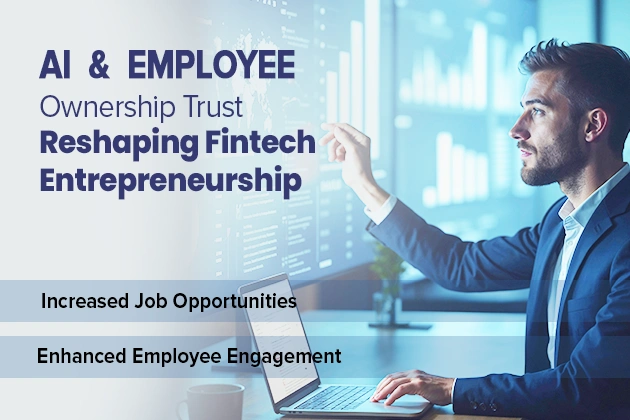
Technological advancements started rewriting banking’s history in 1866, when Cyrus West Field introduced the first transatlantic cable, changing the way banks would do business in the coming centuries. With fintech entrepreneurship giving birth to revolutionary banking services such as ATM, SWIFT, NASDAQ, PayPal, and others, we realized the transformative power of advanced technologies, working as a catalyst to drive economic growth.
An Introduction to Fintech Entrepreneurship
An entrepreneurial ecosystem consists of interdependent subjects and an entrepreneurial environment that either allows or restricts entrepreneurship. Fintech ecosystems support the growth of FinTech companies that contribute to the provision of traditional financial services. A research study has identified that in the first half of 2019, 48 Fintech startups were valued at more than $1 billion, accounting for 1% of the global financial industry. This implies how high the entrepreneurial activity in a FinTech ecosystem becomes an entrepreneurial ecosystem. Through the development of FinTech-friendly regulations and special state programmes, entrepreneurship in the financial sector is developed.
As cutting-edge technologies continue to transform entrepreneurial development, they are implemented by the financial world to help financial technology form efficient frameworks for financial sectors, such as banks. Fintech is often defined as “technologically enabled financial innovation that might result in new business models, apps, processes, or products with an associated substantial influence on financial markets and institutions and the supply of financial services.”
With the key goal of making financial services more accessible and efficient for customers by coupling traditional financial services with cutting-edge technology, fintech entrepreneurs are coming up with innovative fintech business ideas. The number of startups in the fintech sector is rapidly mushrooming by leveraging creative business models to attract and engage consumers.
With the integration of the latest technologies like AI and other advanced techniques, entrepreneurs in the field are reshaping banking, investment, and other financial services. Let’s discover how.
Fintech Entrepreneurship in the Age of AI
Fintech entrepreneurship today sits at the crossroads of automation and empowerment—where artificial intelligence reshapes financial jobs. Studies have shown that AI has already transformed the operational core of this industry, with 61% of customer queries handled by AI chatbots, 75% of U.S. banks leveraging this technology to accelerate lending decisions, and predictive analytics helping cut operational costs by 14% globally. This proves that machines are not mere assistants but productive engines.
The fintech revolution is no longer about speed alone—it’s about redefining who does the work and who owns the outcomes. From streamlining financial processes to enhancing business partnerships through relevant information sharing, AI is revolutionizing the fintech industry. AI is foundational to the fintech industry, ensuring efficiency, personalization, security, advanced analytics, scalable growth, algorithmic trading, improved customer experiences, lower costs, powered innovation, data-driven strategies, and expanded financial inclusion. AI in financial services has the potential to bring more people into the traditional financial systems.
A research study on the advancements of AI and Machine Learning (ML) in the fintech industry has mentioned that, “The confluence of Artificial Intelligence (AI) and Machine Learning (ML) with the Financial Technology (FinTech) sector has ushered in a paradigm shift, fundamentally altering the contours of financial services. This surge sought not merely to streamline existing processes but to elevate user experiences and propagate financial inclusivity.” According to 2020, the global FinTech market surpassed a staggering $111.8 billion, with a CAGR exceeding 23%. This reflects the indispensable role of AI and ML in the reconfiguration of financial services, steering operational efficiency, fortifying security protocols, and nurturing unprecedented innovation.
Rewriting Fintech Careers Through AI
The AI-driven gains are rewriting job roles—from manual processing and compliance to strategic oversight, model governance, and human-AI collaboration—creating demand for specialized skills such as data science and machine-learning (ML) engineering. To understand AI's impact on jobs, we need to explore how this technology is reshaping financial processes to create job opportunities.
We must understand that the narrative isn’t purely about disruption. A Forbes study explains, “AI in fintech is increasingly positioned as a trust-builder—improving transparency, auditability, and regulatory compliance by logging every automated decision for explainability.” In practice, this shift creates a workforce where humans interpret insights, manage ethical oversight, and shape customer relationships while algorithms handle scale.
As fintech startups proliferate across the United States, AI isn’t merely an efficiency booster — it’s a redefining engine. From real-time fraud detection systems that review millions of transactions per second to personalized robo-advisors that democratize investing, AI is displacing rote grunt work while creating opportunities for new high-value roles that emphasize strategy, oversight, and creativity.
In 2024–2025, fintech companies reported sweeping transformation as AI systems enhanced fraud prevention, automated support, and accelerated decision-making across lending and risk management functions. Even workforce structures are evolving, with companies reallocating talent toward innovation-focused roles instead of transactional tasks, highlighting AI’s role as a job-creator for advanced skill categories rather than a replacement force.
The Forbes study continues to explain that this shift is also cultural. “AI-driven fintech platforms now enable real-time insights, personalization, and predictive modeling—capabilities that deepen customer trust and demand ethical human oversight. Transparent AI systems that track every decision provide accountability in highly regulated financial environments, reinforcing the need for employees who interpret outcomes and ensure responsible implementation.” The future fintech workforce blends technical fluency with creativity, judgement, and empathy; traits that machines cannot replicate.
A Force Reshaping Fintech: The Concept of Employee Ownership Trust in Fintech
Employee ownership trust or shared ownership is a structure where a trust holds a controlling stake or a long-term shareholding in a company on trust to ensure benefits for all employees of the company. This allows owners to sell their business while preserving its legacy, independence, and culture. This shared ownership offers remarkable tax savings and fosters high employee engagement through profit sharing and indirect ownership.
As fintech startups generate exponential value from AI-driven efficiencies, shared ownership structures ensure employees benefit directly from productivity gains rather than being displaced by them. Research shows fintech innovation often encourages companies to invest in human capital through incentives such as equity rewards, training programs, and performance-linked compensation—aligning growth with employee prosperity.
Ownership models facilitate accountability, collective decision-making, and retention, qualities essential in an industry where trust is the currency. Unlike traditional stock options, EOTs are designed for collective well-being, ensuring that as value rises — partly from AI-enhanced productivity — that value circulates with workers, not just founders or external investors.
Amid the backdrop of technological change, employee ownership trusts (EOTs) are gaining traction as a people-centric governance alternative. EOTs not only strengthen retention, but also ensure that employees benefit from efficiency gains as AI scales value creation. By weaving AI’s impact on work with the rising promise of shared ownership, today’s fintech entrepreneurs can build ventures that are not only cutting-edge in technology but anchored in shared purpose and prosperity.
In a sector defined by innovation and disruption, EOTs offer a structural compass pointing toward sustainable growth — where ideas and rewards are distributed more equitably as both machines and humans shape the future of financial services.
With The Silicon Journal, an emerging business magazine in the United States, you are exposed to insights, trends, and news associated with the business world to stay ahead. Our business publication takes pride in its holistic approach to keep the business enthusiasts at the center of the global business world by keeping them informed and empowered to understand the knick-knacks of the global business environment.
Related Articles


Recent Articles





Latest Issue