Organizational CFOs in Driving AI-Powered Change
Artificial Intelligence (AI) has woven itself into daily activities worldwide, a feat few technologies have achieved in recent decades. Whether in bustling offices or cozy homes, AI is reshaping how we work and live. With Enterprise AI adoption, businesses are revolutionizing their operations, strategic decision-making, and customer relationships. From organizational operations to finance management and other activities, AI is sparking a new era of automation, smarter predictions, tailored experiences, and sharper strategies.
Finance, being the backbone of business establishment and smooth operations, requires strategic planning, organizing, controlling, and monitoring of financial resources. Chief Financial Officers (CFOs), who stand at the forefront of business finance management, are leveraging advanced technologies, such as artificial intelligence, to optimize financial resources and ensure their smooth flow across all organizational levels.
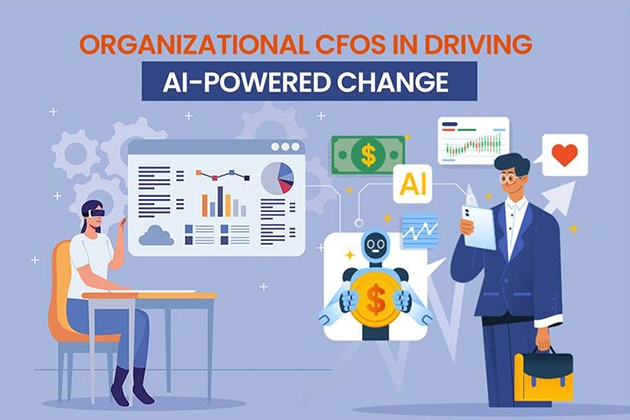
AI-powered automation streamlines finance management processes, helps drive insights to analyze financial data, forecasts, measures performance, improves financial decision-making, and conducts real-time calculations. By leveraging this high-potential technology, organizational CFOs are reshaping business management through efficient use of financial resources.
As an emerging business magazine in the USA, The Silicon Journal delves deeper into every trend and technology that is reimagining businesses in the 21st century. Whether it is finance or energy, our business publication is committed to delivering the latest and most important information that is either associated with or could influence the business world. This article from The Silicon Journal delineates the role of an organizational chief financial officer in driving AI-powered change.
Artificial Intelligence in Enterprise Management
Businesses are deploying AI applications to optimize operations and strategic decision-making. From customer service to product development, AI capabilities like natural processing, machine learning, computer vision, and data analytics transform the ways enterprises manage operations. Key business applications of AI include-
1. Marketing and Sales
With AI-powered data analysis, identifying trends in customer data helps develop targeted marketing campaigns and enables hyper-personalized experiences. These tools foster seamless engagement, allowing customers to transition smoothly across marketing channels. AI empowers businesses to create evidence-based marketing strategies by evaluating consumer behaviors and market patterns. By automating repetitive tasks, AI applications elevate the productivity of marketing and sales teams.
2. Customer Service and Support
Customer support, being one of the most crucial and rigorous business aspects, often increases stress levels and turnover rates of employees working in the customer support team. However, with AI business applications like chatbots, the work burden of employees in this department is halved. By leveraging natural language processing, chatbots can interact with people as per their language preferences. AI applications automate routine support tasks, such as tracking orders or answering FAQs.
3. Supply Chain and Logistics
According to McKinsey, AI applications in the supply chain are expected to reach $2 trillion. The majority of supply chain organizations are investing in generative AI as it can interact through natural language processing. Through these applications, business leaders can ask questions to inform their demand forecasting, risk management, and product planning.
4. IT and Cybersecurity
Cyber criminals are already leveraging AI technology to launch extensive attacks. However, organizational IT teams are retaliating against these attacks by leveraging the same technology, launching a robust cyber defense. AI tools are engineered to monitor network traffic to detect early signs of unauthorized access. These tools can also flag potential scam emails and automate penetration testing to identify weaknesses in an enterprise’s system.
5. Product Development
AI contributes to product development by conducting in-depth analysis of the product’s market suitability. AI applications can accelerate iteration and reduce time to market, can create prototypes in hours instead of weeks, and scan and analyze data on consumer behavior for faster feedback loops.
6. Finance
An effective AI strategy is what an enterprise needs to ensure efficient and optimized financial operations. CFOs nowadays are leveraging various AI applications to better manage financial resources, personalize investment decisions, and automate financial compliance.
7. Human Resources
HR departments of enterprises are also adopting AI tools to perform smart and fast recruitments. By leveraging AI applications, HR departments carry out onboarding tasks after recruitment and provide personalized training plans for employees.
Who is a CFO?
The designation of CFO or Chief Financial Officer is becoming increasingly popular across all scales of businesses. Modern CEOs are relying on an expert financial adviser with financial skills and knowledge that could help them grow their market share and businesses in a competitive market. A CFO is the highest-ranking financial professional in an enterprise or organization who is responsible for the fiscal health of the business.
A CFO’s responsibilities may include ensuring a balance between revenue and expenses, building a skilled finance and accounting team, overseeing financial planning and analysis, obtaining funding, analyzing financial data, budgeting, making mergers and acquisitions-related suggestions, consulting with the board of directors and the CEO on strategy finalization, and attesting to accurate financial reporting. CFOs may also help direct technological integration within the financial department to gain fiscal insights and industry knowledge.
What Role Does a CFO Play in AI-powered Business Transformation?
CFO's role in AI transformation is far-reaching and moves beyond the boundaries of just leveraging technologies. As organizations are rapidly embracing AI, financial experts are integrating this technology into all operations, from customer support to finance management. CFOs strategically tackle organizational finance, which plays a crucial role in technological deployments across all organizational levels. Artificial intelligence stands at the forefront of today’s business transformation, and CFOs, being the financial advisors of businesses, are driving this AI-powered transformation. But before we explore how CFOs do that, let us find out what AI-powered finance transformation means for CFOs.
An AI-powered finance transformation involves a fundamental shift from manual finance processes to intelligent operations. This represents transitioning to autonomous workflows across the Procure-to-Pay, Order-to-Cash, and Record-to-Report cycles. Modern financial platforms combine machine learning, artificial intelligence, intelligent document processing, and robotic process automation to help the financial team conduct repetitive tasks without feeling drained. AI helps reposition finance as a strategic partner in business growth through real-time visibility, data-driven decision-making, and enhanced forecasting.
How CFOs Ensure Financial Transformation through AI Applications?
With AI rapidly transforming the financial landscape, CFOs are harnessing its power to drive stronger financial results and fuel organizational growth. Here are some real-world ways CFOs are using AI to amplify business performance.
1. Smarter Financial Decisions
AI-powered credit scoring enables CFOs to make faster, smarter, and more inclusive lending decisions. Unlike traditional finance models that rely on static credit histories, AI models analyze a broad range of real-time and non-traditional data, including transaction behavior, behavioral signals, employment patterns, behavioral signals, income potential, and equitable credit evaluations. This approach empowers CFOs to optimize risk management while supporting financial inclusion.
2. Risk Assessment and Management
AI-powered tools that increase speed and precision enable CFOs to monitor emerging risks in real time, automate document reviews, and interpret complex regulatory frameworks easily. This reduces financial risk and also amplifies confident decision-making.
3. Fraud Detection and Prevention
By enabling real-time monitoring of transaction patterns, CFOs are leveraging AI to transform fraud detection. These tools help CFOs enhance financial security, ensure compliance with regulatory frameworks, and reduce fraud-driven losses. AI analyzes a vast amount of data to detect complex patterns and behaviors.
4. Financial Advisory and Wealth Management
Modern CFOs are increasingly relying on AI to transform wealth management by coupling data intelligence with personalization, speed, and accuracy. AI platforms analyze market trends, risk profiles, and financial goals to help generate tailored investment decisions. By augmenting AI-enabled insights with human judgment, CFOs are reimagining traditional wealth strategies.
5. Personalized Banking
By using AI-powered chatbots, CFOs are transforming financial operations and customer experiences. For example, Bank of America’s Erica shows how AI processes billions of interactions to offer predictive insights and automates financial tasks. Through intelligent automation, they are delivering personalized banking options to customers, unlocking new doors to revenue growth, cost savings, and financial resilience.
6. Capital Market Research
Investment firms always need to stay at the edge of capital markets, acquiring knowledge about them to make informed and intelligent investment decisions for their clients. CFOs of these firms are using Generative AI to revolutionize capital markets research, as it works as a research assistant for analysts. By scanning millions of documents, it can extract relevant information in seconds. This allows CFOs to make smarter investment decisions.
7. Financial Document Synthesis
An effective CFO AI strategy could make complex financial operations as smooth as silk. Financial institutions often spend considerable resources and time on locating, reviewing, and summarizing internal documents, making the process even more complex when dealing with unstructured data across systems. However, with Generative AI, CFOs can now rapidly search through a huge repository of documents and draw out relevant insights.
Related Articles


Recent Articles




Latest Issue